
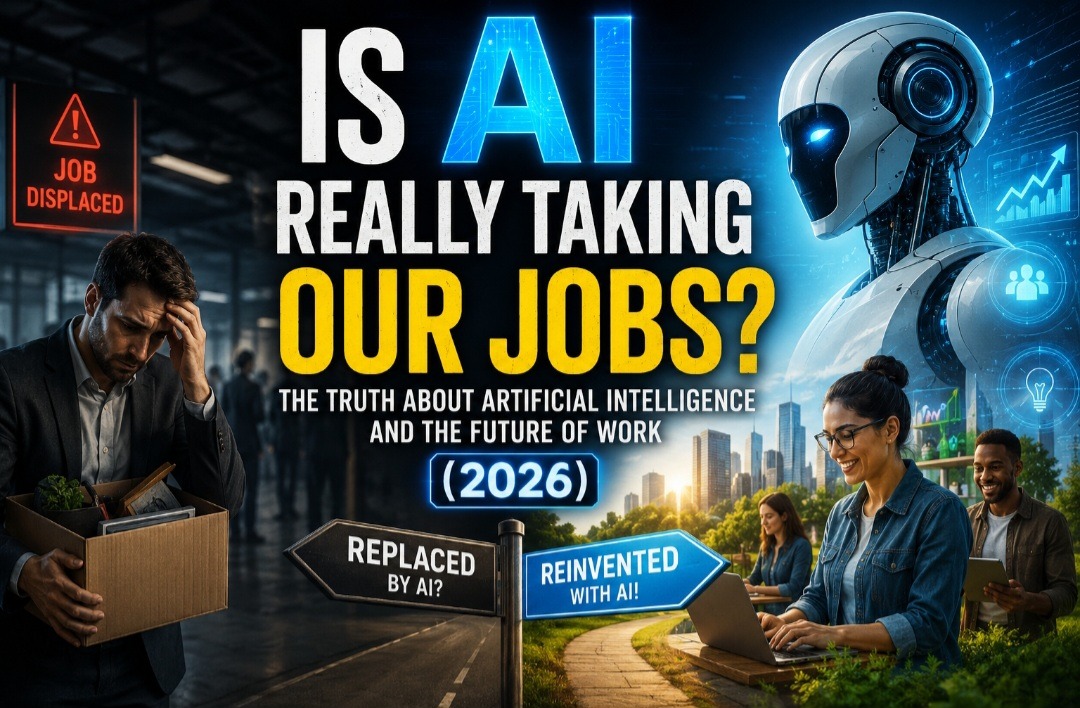
Is AI Really Taking Our Jobs? The Truth About Artificial Intelligence and the Future of Work (2026)
Will AI replace human jobs? Learn which careers are at risk, which are growing, and how you can prepare for the AI-powered future in 2026.
Is AI Really Taking Our Jobs? The Truth About Artificial Intelligence and the Future of Work (2026)
Introduction
Artificial Intelligence (AI) is no longer a futuristic concept—it is already transforming the way we live, work, and interact with technology. From virtual assistants like Siri and Google Assistant to AI-powered tools such as ChatGPT, GitHub Copilot, and self-driving vehicles, AI has become an integral part of modern life. Businesses across industries are rapidly adopting AI to improve efficiency, reduce costs, and automate repetitive tasks.
As AI continues to evolve, one question dominates conversations among students, professionals, and employers alike: "Is AI really taking our jobs?"
The answer is more complex than a simple yes or no. While AI is replacing certain routine tasks and changing the nature of work, it is also creating entirely new career opportunities and increasing the demand for skilled professionals who can work alongside AI.
Rather than fearing AI, it is important to understand its capabilities, limitations, and impact on different industries. This article explores how AI is reshaping the global workforce, which jobs are at risk, which careers remain secure, and how students and professionals can prepare for the future.
Table of Contents
1. What is Artificial Intelligence?
2. The History and Evolution of AI
3. How AI Works
4. Types of Artificial Intelligence
5. AI Technologies Powering the Future
6. AI in Everyday Life
7. Why Businesses Are Investing in AI
8. Common Myths About AI
9. How AI Is Changing the Way We Work
10. Key Takeaways
What is Artificial Intelligence?
Artificial Intelligence (AI) refers to computer systems that can perform tasks normally requiring human intelligence. These tasks include learning, reasoning, problem-solving, language understanding, image recognition, decision-making, and even creativity.
Unlike traditional software that follows fixed instructions, AI learns from data and improves over time through experience. This ability allows AI systems to adapt to new situations and make increasingly accurate predictions.
Some common examples of AI include:
ChatGPT
Google Gemini
Siri
Google Assistant
Alexa
Self-driving cars
Face recognition systems
Netflix recommendation engine
Spam email filters
AI chatbots
AI is already integrated into smartphones, healthcare systems, banks, schools, factories, online shopping platforms, and social media applications.
The History and Evolution of AI
Artificial Intelligence has evolved significantly over the past 70 years.
1950 – The Beginning
British mathematician Alan Turing introduced the famous "Turing Test," suggesting that machines could potentially imitate human intelligence.
1956 – Birth of AI
The term "Artificial Intelligence" was officially introduced during the Dartmouth Conference in the United States.
1980s – Expert Systems
Companies began using AI-based expert systems to assist in medical diagnosis, financial planning, and industrial decision-making.
1997 – Deep Blue
IBM's Deep Blue became the first computer to defeat world chess champion Garry Kasparov.
2011 – IBM Watson
IBM Watson defeated top contestants on the quiz show Jeopardy!, demonstrating remarkable language-processing capabilities.
2022–Present – Generative AI Revolution
The release of advanced AI tools like ChatGPT, image generators, and coding assistants made AI accessible to millions of users worldwide.
Today, AI is advancing faster than ever before and is expected to become even more powerful in the coming years.
How AI Works
Artificial Intelligence works by processing large amounts of data, identifying patterns, and making decisions based on those patterns.
The AI workflow typically involves five steps:
1. Data Collection
AI systems collect information from images, videos, documents, websites, sensors, and user interactions.
2. Data Processing
The collected data is cleaned and organized to remove errors and inconsistencies.
3.Model Training
Machine learning algorithms analyze the data and learn patterns.
4. Prediction
After training, AI can make predictions, answer questions, recognize objects, or generate content.
5. Continuous Learning
Many AI systems improve automatically as they receive more data and feedback.
For example, YouTube recommends videos based on your watch history because its AI learns your preferences over time.
Types of Artificial Intelligence
AI can be categorized into three major types.
1. Narrow AI
This is the most common form of AI today.
It performs specific tasks exceptionally well but cannot perform unrelated activities.
Examples include:
Voice assistants
Recommendation systems
Chatbots
Navigation apps
2. General AI
General AI refers to machines capable of performing any intellectual task that a human can perform.
Currently, General AI does not exist and remains an active area of research.
3. Super AI
Super AI is a hypothetical concept where machines surpass human intelligence in every field.
Experts continue to debate whether Super AI will ever become reality.
AI Technologies Powering the Future
Several technologies work together to make AI possible.
Machine Learning (ML)
Machine Learning enables computers to learn from data without explicit programming.
Applications include:
Fraud detection
Recommendation systems
Price prediction
Deep Learning
Deep Learning uses neural networks inspired by the human brain.
Applications include:
Image recognition
Speech recognition
Autonomous vehicles
Natural Language Processing (NLP)
NLP enables computers to understand and generate human language.
Examples include:
ChatGPT
Google Translate
AI customer support
Computer Vision
Computer Vision allows machines to interpret images and videos.
Applications include:
Face recognition
Medical image analysis
Security surveillance
Robotics
AI-powered robots perform repetitive, dangerous, or highly precise tasks in industries such as manufacturing and healthcare.
AI in Everyday Life
Many people use AI daily without realizing it.
Examples include:
Smartphones
Face Unlock
Voice assistants
Camera enhancements
Social Media
Personalized feeds
Friend suggestions
Content recommendations
Online Shopping
Product recommendations
Dynamic pricing
Customer support chatbots
Banking
Fraud detection
Credit scoring
Personalized financial advice
Healthcare
Disease prediction
Medical imaging
Drug discovery
Education
Personalized learning
AI tutors
Automated grading
Transportation
GPS navigation
Traffic prediction
Self-driving technology
Why Businesses Are Investing in AI
Companies worldwide are investing billions in AI because it offers numerous benefits.
Increased Productivity
AI performs repetitive tasks much faster than humans.
Cost Reduction
Automation reduces labor costs and operational expenses.
Improved Accuracy
AI minimizes human errors in calculations and data processing.
Better Customer Experience
AI chatbots provide instant responses 24/7.
Faster Decision-Making
AI analyzes massive datasets within seconds.
Personalized Services
Streaming platforms and online stores recommend products based on user preferences.
Common Myths About AI
Myth 1: AI Will Replace Every Job
Reality: AI automates specific tasks, not every responsibility within a profession.
Myth 2: AI Thinks Like Humans
Reality: AI processes patterns and data but does not possess emotions, consciousness, or human understanding.
Myth 3: Only Tech Companies Use AI
Reality: Healthcare, agriculture, banking, education, retail, logistics, entertainment, and manufacturing all rely on AI.
Myth 4: AI Is Always Accurate
Reality: AI can make mistakes if it is trained on poor-quality or biased data.
Myth 5: AI Is Dangerous by Default
Reality: AI is a tool. Its impact depends on how responsibly humans develop and use it.--
How AI Is Changing the Way We Work
AI is changing work in almost every industry.
Instead of replacing all workers, AI is handling repetitive tasks so humans can focus on creativity, strategy, communication, leadership, and innovation.
For example:
Doctors use AI to analyze medical scans.
Teachers use AI to prepare lesson plans.
Software developers use AI coding assistants.
Writers use AI for research and editing.
Designers use AI image-generation tools.
Customer support teams use AI chatbots for common queries.
This shift means future careers will increasingly require people to work with AI rather than compete against it.
Key Takeaways
Artificial Intelligence is transforming industries worldwide.
AI is already part of our everyday lives.
AI automates repetitive tasks but does not replace every profession.
Businesses use AI to improve productivity, accuracy, and customer experience.
Learning AI-related skills can significantly improve future career opportunities.
Next in Part 2: We'll explore which jobs are most at risk from AI, which careers are safest, how AI is creating new jobs, and what students and professionals should do to stay relevant in the AI era.
Extra pointers for Indian readers
The guide above stays the main reference. The table and questions below help you act on it – compare providers, confirm fees, and search locally when you are ready.
At a glance
| What to check | Why it matters | What "good" looks like |
|---|---|---|
| Scope of work / service | Stops bill shock later | Written line items, not one lump sum |
| Service area | Travel fees add up | Clear pincode or landmark coverage |
| Reviews (recent) | Old 5-stars mislead | Patterns about timing, billing, attitude |
| Response time | Shows reliability | Same-day reply during business hours |
| Cancellation rules | Protects your deposit | Plain language on WhatsApp or email |
| Extra fees | Budget planning | Quoted before work starts |
Figures and timelines vary by city and provider — use this table for planning, not as a price guarantee.
Save this page if you are mid-search – you can rerun the same checks for the next service you hire.
Frequently asked questions
Is Is AI Really Taking Our Jobs? The Truth About Artificial Intelligence and the Fu different in metro cities and smaller towns?
Usually yes. Availability, pricing, and travel charges shift between metros and tier-2 cities. Filter by your city or locality, then confirm service area on a quick phone call before you pay.
How do I know if a listing for will ai replace human jobs? learn which careers are at risk, which are growing, is still active?
Treat online hours as a hint. Call or WhatsApp the number on the listing, ask if they take new bookings this week, and note who you spoke with. That single step prevents many wasted trips.
What should I prepare before contacting providers about will ai replace human jobs? learn which careers are at risk, which are growing,?
Have your location landmark, preferred date or time window, budget range, and any must-haves written down. Providers answer faster when your brief is specific instead of "how much?" alone.
How local is "near me" in practice?
Search tools use city and locality pins, but providers may still charge travel outside a radius. Confirm they serve your pincode or landmark before scheduling.
Is the cheapest quote always the best deal?
Rarely. Lower quotes may exclude tax, travel, materials, or cleanup. Compare line items and ask what happens if the job runs long or needs a return visit.
Do prices for will ai replace human jobs? learn which careers are at risk, which are growing, include GST?
Not always on the first quote. Ask whether GST is extra, whether you need a formal invoice, and what name will appear on the bill – especially for business reimbursements.
Does it matter which city I search from (e.g. Chennai)?
Yes. Start with your actual city or locality filter. A great provider in another city is irrelevant if they will not travel to you without heavy surcharges.
Can I pay in cash or UPI – what is safer?
UPI with a note in WhatsApp is common and leaves a trail. For large event or renovation payments, staged transfers tied to milestones reduce risk for both sides.
How do I report outdated information on a listing?
Use contact options on VedList Discover or reach support if something looks wrong. Owners can also claim listings to correct phone numbers and hours directly.
Should I call or WhatsApp first?
WhatsApp lets you share location pins and photos; calls resolve urgent timing faster. Try the channel the listing promotes, then switch if nobody responds within a reasonable window.