
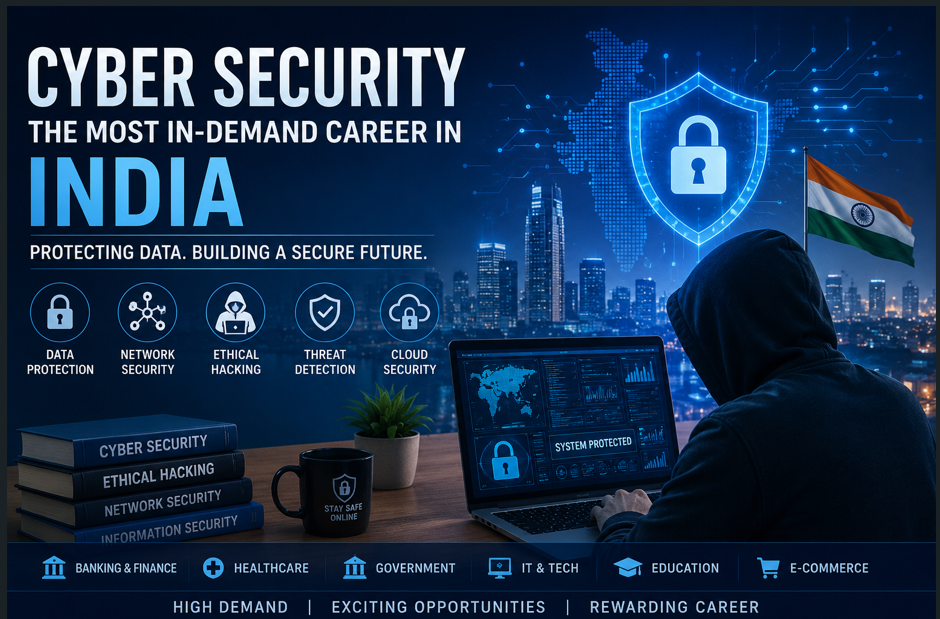
Best Cyber Security Courses with Placement in India
Cyber security has become one of the fastest-growing career fields in India and around the world. As businesses, governments, banks, hospitals, and educational institutions increasingly rely on digital systems, protecting sensitive data from cyber attacks has become a top priority
Best Cyber Security Courses with Placement in India (2026): Top 10 Institutes, Fees, Eligibility & Salary Guide
Introduction
Cyber security has become one of the fastest-growing career fields in India and around the world. As businesses, governments, banks, hospitals, and educational institutions increasingly rely on digital systems, protecting sensitive data from cyber attacks has become a top priority.
According to industry reports, India faces thousands of cyber attacks every day, creating a massive demand for skilled cyber security professionals. Companies are actively hiring Cyber Security Analysts, Ethical Hackers, Penetration Testers, SOC Analysts, and Information Security Engineers, often offering attractive salary packages and excellent career growth.
If you are a student, graduate, or working professional looking to build a high-paying career, choosing the right cyber security course with placement support can give you a strong advantage.
In this comprehensive guide, we'll explore the best cyber security institutes in India, compare their fees, placement support, eligibility, course curriculum, certifications, and career opportunities to help you make an informed decision.
Why Choose Cyber Security as a Career in 2026?
Cyber security is no longer just an IT specialization—it has become a critical business function. Every organization needs skilled professionals to protect digital assets from cyber threats.
Reasons to Choose Cyber Security
High demand across industries
Excellent salary packages
Strong job security
Global career opportunities
Remote work options
Continuous learning and career growth
Opportunities in both government and private sectors
Unlike many careers that are becoming automated, cyber security requires human expertise for threat analysis, ethical hacking, digital forensics, and incident response.
Cyber Security Market in India
The Indian cyber security industry is growing rapidly due to:
Digital India initiatives
Expansion of cloud computing
Growth of fintech and online banking
Increase in ransomware attacks
AI-driven cyber threats
Government focus on cyber defense
Thousands of cyber security positions remain unfilled every year because there is a shortage of qualified professionals.
Why Companies Hire Cyber Security Professionals
Every organization wants to protect:
Customer data
Financial transactions
Company servers
Websites
Mobile applications
Cloud infrastructure
Employee information
Intellectual property
Industries hiring cyber security professionals include:
IT Companies
Banking & Finance
Government Organizations
Healthcare
E-commerce
Telecom
Manufacturing
Startups
EdTech
Defence
Who Should Join a Cyber Security Course?
Cyber security is suitable for:
12th Pass Students
BCA Students
B.Tech Students
B.Sc IT Students
MCA Students
Computer Science Graduates
Software Developers
Network Engineers
Working Professionals
Career Switchers
Eligibility Criteria
Different institutes have different eligibility requirements.
Basic Eligibility
10+2 (for foundation programs)
Graduation for advanced certification
Basic computer knowledge
Interest in networking and security
No prior cyber security experience is required for beginner courses.
Skills Required Before Learning Cyber Security
You don't need to master everything before starting, but having these skills will help.
Technical Skills
Computer Fundamentals
Networking Basics
Linux Operating System
Windows Administration
Internet Technologies
Basic Programming
Database Fundamentals
Soft Skills
Problem Solving
Logical Thinking
Communication
Analytical Skills
Curiosity
Continuous Learning
What Will You Learn?
A good cyber security course covers:
Network Security
Linux Administration
Windows Security
Ethical Hacking
Penetration Testing
Web Application Security
Wireless Security
Cloud Security
Cryptography
Malware Analysis
Incident Response
Digital Forensics
Security Operations Center (SOC)
Vulnerability Assessment
Risk Management
Security Auditing
Top 5 Best Cyber Security Institutes in India
1. Indian Institute of Technology (IIT) Madras
Overview
IIT Madras offers industry-oriented cyber security programs designed for students, graduates, and working professionals who want to specialize in information security.
Highlights
Prestigious IIT certification
Experienced faculty
Industry-focused curriculum
Hands-on practical learning
Live projects
Strong alumni network
Course Duration
6–12 Months
Mode
Online
Hybrid
Approximate Fees
₹1,00,000–₹2,50,000 (varies by program)
What You'll Learn
Ethical Hacking
Cyber Defense
Cloud Security
Network Security
Incident Response
Digital Forensics
Placement Support
Career guidance
Industry networking
Resume support
Interview preparation
Pros
Highly reputed institute
Excellent curriculum
Industry-recognized certificate
Quality learning experience
Cons
Competitive admission
Higher course fees
2. Indian Institute of Technology (IIT) Kanpur
Overview
IIT Kanpur provides advanced cyber security training with practical labs and real-world projects.
Course Highlights
Hands-on learning
Cyber labs
Industry projects
Expert instructors
Duration
6–9 Months
Course Fees
₹1,20,000–₹2,00,000
Topics Covered
Ethical Hacking
Penetration Testing
Linux
Security Testing
Network Security
Cloud Security
Placement Support
Career mentoring
Resume assistance
Mock interviews
Pros
Excellent reputation
Practical exposure
Strong curriculum
Cons
Premium pricing
Limited seats
3. Indian Institute of Information Technology (IIIT) Bangalore
Overview
IIIT Bangalore is one of India's leading technology institutes and offers specialized cyber security programs focusing on practical skills and modern security technologies.
Course Highlights
Industry-relevant curriculum
Practical assignments
Case studies
Expert faculty
Capstone projects
Duration
8–12 Months
Fees
₹1,00,000–₹2,20,000
Skills Covered
Security Operations
Threat Intelligence
Ethical Hacking
Cloud Security
Risk Assessment
Digital Forensics
Placement Support
Career guidance
Resume building
Interview preparation
Industry networking
Pros
Industry-recognized certification
Practical learning
Excellent faculty
Cons
Moderate to high fees
Requires consistent study commitment
4. Centre for Development of Advanced Computing (CDAC)
Overview
CDAC is a premier government organization offering specialized cyber security programs that are highly valued in both government and private sectors.
Course Highlights
Government-backed certification
Affordable compared to many private institutes
Hands-on labs
Focus on real-world cyber security
Duration
6–9 Months
Fees
₹50,000–₹1,20,000
Curriculum
Ethical Hacking
Network Security
Secure Coding
Digital Forensics
Information Security
Cyber Laws
Placement Support
Campus placement assistance
Industry tie-ups
Career counseling
Pros
Government recognition
Affordable fees
Strong technical foundation
Cons
Admission may require entrance criteria for some programs
Limited seats in popular centers
5. National Forensic Sciences University (NFSU)
Overview
NFSU is one of India's leading institutions for cyber security, digital forensics, and information security education. It is especially well-known for students interested in cyber crime investigation and digital evidence.
Highlights
Specialized cyber security programs
Strong focus on digital forensics
Modern laboratories
Collaboration with government agencies
Duration
Varies by certificate, diploma, and degree program
Fees
₹60,000–₹2,00,000 (depending on the course)
Topics Covered
Cyber Crime Investigation
Ethical Hacking
Digital Forensics
Malware Analysis
Incident Response
Information Security Management
Placement Support
Internship opportunities
Placement assistance
Industry and government collaborations
Pros
Excellent for forensic and cyber crime careers
Practical lab experience
Government-recognized university
Cons
Some programs have limited intake
Course availability varies by campus
Why These Institutes Stand Out
These institutes are recognized for:
Experienced faculty and industry experts
Updated curriculum aligned with current cyber threats
Practical labs and real-world projects
Placement assistance and career support
Certifications valued by employers
Best Cyber Security Courses with Placement in India (2026)
6. Indian Institute of Technology (IIT) Delhi
Overview
IIT Delhi offers cybersecurity-focused certificate and executive education programs that emphasize network security, cryptography, cloud security, and cyber defense. These programs are ideal for graduates and working professionals looking to build advanced security skills.
Course Highlights
IIT-certified program
Live online classes
Case studies
Hands-on assignments
Industry-relevant curriculum
Duration
6–8 Months
Approximate Fees
₹1.2–2.0 Lakhs
Placement Support
Career guidance
Resume building
Interview preparation
Best For
Working professionals
B.Tech/BCA/MCA graduates
Software developers
Pros
Prestigious IIT brand
Updated curriculum
Experienced faculty
Cons
Premium fee
Limited seats
7. Indian School of Ethical Hacking (ISOEH)
Overview
ISOEH specializes in ethical hacking and penetration testing with practical, lab-based learning. It is a popular choice for students seeking job-ready offensive security skills. (EDOXI)
Duration
3–12 Months
Approximate Fees
₹40,000–₹1,50,000
Topics Covered
Ethical Hacking
Penetration Testing
Web Security
Mobile Security
Bug Bounty
Digital Forensics
Placement Support
Resume preparation
Interview training
Internship assistance
Pros
Practical training
Beginner friendly
Industry tools
Cons
Certification value depends on employer
Less research-focused than IITs
8. EC-Council India
Overview
EC-Council is globally recognized for certifications such as Certified Ethical Hacker (CEH), Certified Security Analyst (ECSA), and Certified Chief Information Security Officer (CCISO). These certifications are highly valued by employers worldwide. (EDOXI)
Duration
3–6 Months
Approximate Fees
₹70,000–₹1,80,000
Best Certifications
CEH
CHFI
ECSA
CCISO
Placement Support
Depends on the training partner.
Pros
International recognition
Excellent for ethical hacking careers
Cons
Exam fees can be expensive
Focuses on certification rather than a full academic program
9. Koenig Solutions
Overview
Koenig Solutions is known for instructor-led training in cybersecurity, cloud security, Microsoft security, Cisco security, and ethical hacking. (EDOXI)
Duration
1–6 Months
Approximate Fees
₹60,000–₹2,00,000
Course Highlights
Live online classes
Practical labs
Vendor certifications
Best For
Professionals looking for certification-focused training.
Pros
Flexible schedules
International certifications
Cons
Limited placement assistance
10. Craw Security
Overview
Craw Security is a well-known training institute offering practical cybersecurity education with hands-on labs, ethical hacking practice, and career guidance. (EDOXI)
Duration
3–12 Months
Approximate Fees
₹50,000–₹1,20,000
Courses Offered
Ethical Hacking
SOC Analyst
Penetration Testing
Digital Forensics
Network Security
Placement Support
Internship opportunities
Placement assistance
Career mentoring
Pros
Practical learning
Good lab exposure
Suitable for beginners
Cons
Brand recognition is lower than IITs and C-DAC
Cyber Security Institutes Comparison
Institute
Approx. Fees
Duration
Placement Support
Best For
IIT Madras
₹1–2.5 Lakh
6–12 Months
Yes
Professionals
IIT Kanpur
₹1.2–2 Lakh
6–9 Months
Yes
Advanced learners
IIIT Bangalore
₹1–2.2 Lakh
6–8 Months
Yes
Students & professionals
C-DAC
₹50k–1.2 Lakh
6 Months
Yes
Freshers
NFSU
₹60k–2 Lakh
Varies
Yes
Digital Forensics
IIT Delhi
₹1.2–2 Lakh
6–8 Months
Yes
Professionals
ISOEH
₹40k–1.5 Lakh
3–12 Months
Yes
Beginners
EC-Council
₹70k–1.8 Lakh
3–6 Months
Depends
Global certifications
Koenig Solutions
₹60k–2 Lakh
1–6 Months
Limited
Working professionals
Craw Security
₹50k–1.2 Lakh
3–12 Months
Yes
Entry-level learners
Fees and program structures vary by course and admission cycle. Always verify the latest details before applying.
Average Placement Packages
Experience
Expected Salary
Fresher
₹4–8 LPA
2–5 Years
₹8–15 LPA
5–10 Years
₹15–30 LPA
Senior Experts
₹30–60+ LPA
Top Recruiters
Leading recruiters include:
TCS
Infosys
Wipro
Accenture
Deloitte
IBM
Capgemini
HCLTech
Tech Mahindra
Cisco
Palo Alto Networks
Microsoft
Google
Amazon
Deloitte Cyber Risk
Job Roles After Completing a Cyber Security Course
Cyber Security Analyst
Ethical Hacker
Penetration Tester
SOC Analyst
Information Security Analyst
Security Engineer
Incident Response Analyst
Malware Analyst
Digital Forensics Expert
Cloud Security Engineer
Security Consultant
Security Architect
Skills Companies Expect
Linux
Networking
Python Basics
Windows Security
Wireshark
Burp Suite
Metasploit
Nmap
SIEM Tools
OWASP Top 10
Cloud Security
Risk Assessment
Incident Response
Best Institute Based on Your Goal
Goal
Recommended Institute
Best Overall
IIT Madras
Best Government Option
C-DAC
Best Ethical Hacking
EC-Council / ISOEH
Best Digital Forensics
NFSU
Best Value for Money
C-DAC
Best Executive Program
IIIT Bangalore
Best for Beginners
Craw Security
How to Choose the Right Cyber Security Course
Choosing the right cyber security course is one of the most important decisions for your career. A good course should not only teach theoretical concepts but also provide hands-on practical experience, industry-recognized certifications, internship opportunities, and placement support.
Before enrolling in any course, consider the following factors:
1. Check the Institute's Reputation
Always choose an institute with a strong reputation in the industry. Government institutions like IITs, IIITs, C-DAC, and NFSU, along with reputed private training organizations, generally offer better-quality education and stronger industry recognition.
Why It Matters
Better learning environment
Experienced faculty
Better placement opportunities
Higher employer trust
2. Look at the Course Curriculum
A good cyber security course should include:
Ethical Hacking
Network Security
Linux Administration
Windows Security
Web Application Security
Penetration Testing
Digital Forensics
Cloud Security
Malware Analysis
Security Operations Center (SOC)
Incident Response
Risk Management
OWASP Top 10
Secure Coding
Avoid courses that only focus on theory without practical labs.
3. Practical Labs
Cyber security is a practical field.
Choose an institute that provides:
Virtual Labs
Capture The Flag (CTF) Challenges
Live Projects
Vulnerability Assessment Practice
Penetration Testing Practice
Bug Hunting Exercises
Security Simulation
The more practical experience you gain, the easier it becomes to secure a job.
4. Placement Assistance
Ask these questions before joining:
Does the institute provide placement support?
What companies recruit students?
Are internships available?
Is resume preparation included?
Are mock interviews conducted?
What is the average salary offered?
5. Industry Certifications
Good institutes prepare students for internationally recognized certifications.
Popular certifications include:
Certified Ethical Hacker (CEH)
CompTIA Security+
Cisco CyberOps Associate
Microsoft Security Certifications
Certified Information Systems Security Professional (CISSP) (recommended after gaining work experience)
Offensive Security Certified Professional (OSCP) (advanced level)
Online vs Offline Cyber Security Courses
Many students wonder whether they should choose an online or offline course. The right option depends on your learning style, budget, and schedule.
Feature | Online Course | Offline Course |
|---|---|---|
Flexibility | Excellent | Limited |
Practical Labs | Good (if included) | Excellent |
Networking | Moderate | Excellent |
Cost | Usually lower | Usually higher |
Classroom Experience | No | Yes |
Suitable For | Working professionals, college students | Full-time learners |
Which One Should You Choose?
Choose an Online Course if:
You are a college student.
You have a limited budget.
You prefer learning at your own pace.
You are already working.
Choose an Offline Course if:
You want classroom interaction.
You learn better through face-to-face guidance.
You want daily practical lab access.
You are looking for campus placement opportunities.
Cyber Security Learning Roadmap
Step 1: Learn Computer Fundamentals
Operating Systems
Internet Basics
File Systems
Computer Hardware
Step 2: Learn Networking
Topics:
IP Addressing
TCP/IP
DNS
HTTP/HTTPS
Routers
Switches
VPN
Firewalls
Networking forms the foundation of cyber security.
Step 3: Learn Linux
Learn:
Linux Commands
File Permissions
Shell Scripting
User Management
Package Installation
Networking Commands
Linux is widely used by security professionals.
Step 4: Learn Programming
Focus on:
Python
JavaScript (basic)
Bash Scripting
SQL
Programming helps automate security tasks and understand vulnerabilities.
Step 5: Learn Ethical Hacking
Topics include:
Reconnaissance
Information Gathering
Scanning
Enumeration
Exploitation (in legal lab environments only)
Privilege Escalation
Reporting
Always practice in authorized environments such as labs and CTF platforms.
Step 6: Learn Web Security
Study:
SQL Injection
Cross-Site Scripting (XSS)
Cross-Site Request Forgery (CSRF)
Authentication & Authorization
Session Management
API Security
OWASP Top 10
Step 7: Learn Cloud Security
Cloud platforms to know:
AWS
Microsoft Azure
Google Cloud Platform
Cloud security skills are increasingly in demand.
Step 8: Practice Daily
Use legal learning platforms:
Capture The Flag (CTF) challenges
Virtual labs
Security practice environments
Home lab setup
Practical experience is essential.
Cyber Security Career Roadmap (2026–2032)
Year 1
Learn:
Networking
Linux
Security Basics
Python
Ethical Hacking Fundamentals
Expected Salary:
₹4–6 LPA
Year 2
Develop skills in:
Penetration Testing
Web Security
Vulnerability Assessment
Security Tools
Expected Salary:
₹6–9 LPA
Year 3
Specialize in:
Cloud Security
Incident Response
Digital Forensics
Malware Analysis
Expected Salary:
₹8–12 LPA
Year 4–5
Advance into:
Security Engineering
Security Consulting
Security Architecture
Team Leadership
Expected Salary:
₹12–20+ LPA
Future Scope of Cyber Security
Cyber security will remain one of the fastest-growing technology careers over the next decade.
Emerging Areas
Artificial Intelligence Security
Cloud Security
Zero Trust Architecture
Cyber Threat Intelligence
Blockchain Security
IoT Security
Automotive Cyber Security
Mobile Security
DevSecOps
Ransomware Defense
Professionals with practical skills in these areas are expected to see strong demand.
Government Job Opportunities
Cyber security professionals are also recruited by:
CERT-In
DRDO
ISRO
NIC
Intelligence organizations
Public Sector Banks
State Cyber Cells
Law enforcement agencies
Government roles often involve cyber defense, digital forensics, and incident response.
Top Recruiters in India
Some of the leading employers include:
TCS
Infosys
Wipro
Accenture
Deloitte
IBM
Capgemini
HCLTech
Tech Mahindra
Cisco
Microsoft
Google
Amazon
Palo Alto Networks
CrowdStrike
Advantages of Choosing Cyber Security
High salary potential
Strong job demand
Global career opportunities
Remote work options
Continuous learning
Multiple specialization paths
Opportunities in government and private sectors
Skills remain valuable across industries
Challenges of a Cyber Security Career
Requires continuous learning
Technology changes rapidly
Can involve handling high-pressure situations
Certifications may require ongoing renewal
Some roles include shift work, especially in Security Operations Centers (SOCs)
Common Mistakes Beginners Should Avoid
Focusing only on certificates without practical skills
Ignoring networking and Linux fundamentals
Skipping hands-on practice
Not building a portfolio of projects
Learning too many tools without understanding the basics
Expecting a high salary immediately without experience
Practicing on systems without authorization (always stay within legal and ethical boundaries)
Final Tips for Students
Build strong networking and Linux fundamentals.
Practice consistently in legal lab environments.
Create a portfolio showcasing projects, CTF achievements, and write-ups.
Earn recognized certifications at the right stage of your career.
Keep learning as cyber threats and technologies evolve.
Conclusion
Cyber security has emerged as one of the most promising and future-proof career options in India. With the increasing number of cyber threats, data breaches, ransomware attacks, and digital transformation across industries, the demand for skilled cyber security professionals continues to rise.
Whether you are a 12th-pass student, BCA, B.Tech, B.Sc., MCA student, or a working professional, learning cyber security can open the door to high-paying careers in India and abroad.
When choosing a cyber security course, don't focus only on the course fee or institute name. Instead, compare the curriculum, practical labs, placement assistance, industry certifications, faculty, internship opportunities, and alumni success stories.
If you're looking for a government-backed program, C-DAC and NFSU are excellent choices. If you want the prestige of an IIT certification, IIT Madras, IIT Delhi, or IIT Kanpur are among the strongest options. For students specifically interested in ethical hacking, certifications such as CEH and institutes with hands-on lab training can provide a solid foundation.
Remember, your success in cyber security depends not only on the course you choose but also on continuous practice, ethical learning, certifications, and real-world experience.
Invest in your skills today, and you'll be well-positioned for one of the fastest-growing careers of the next decade.
Frequently Asked Questions (FAQs)
1. Which is the best cyber security course in India?
Top choices include IIT Madras, IIT Kanpur, IIIT Bangalore, C-DAC, and NFSU. The best option depends on your budget, learning goals, and preferred learning mode.
2. Is cyber security a good career in 2026?
Yes. Cyber security continues to offer strong demand, competitive salaries, and opportunities across IT, finance, healthcare, government, and other industries.
3. What is the average salary after a cyber security course?
Freshers: ₹4–8 LPA
2–5 Years: ₹8–15 LPA
Experienced Professionals: ₹15–30+ LPA
Actual salaries vary by role, skills, company, and location.
4. Can I learn cyber security after 12th?
Yes. Many institutes offer beginner-friendly certificate and diploma programs. Building a strong foundation in networking, operating systems, and programming is recommended.
5. Is coding required for cyber security?
Basic programming knowledge (especially Python and scripting) is helpful, but many beginner roles don't require advanced coding skills initially.
6. Which certification is best for beginners?
Popular beginner certifications include:
CompTIA Security+
Certified Ethical Hacker (CEH)
Cisco CyberOps Associate
7. Which companies hire cyber security professionals?
Major recruiters include TCS, Infosys, Wipro, IBM, Accenture, Deloitte, Cisco, Microsoft, Google, Amazon, Capgemini, and HCLTech.
8. Is cyber security difficult to learn?
It requires dedication and continuous learning, but beginners can succeed with consistent practice and a structured learning path.
9. Can non-IT students learn cyber security?
Yes. Students from non-IT backgrounds can transition into cyber security by learning networking, operating systems, security fundamentals, and practical tools.
10. Which programming language is best for cyber security?
Python is the most commonly recommended language for beginners. Knowledge of Bash, PowerShell, SQL, and JavaScript is also valuable depending on the specialization.
11. Which cyber security specialization pays the highest?
Some of the highest-paying areas include:
Cloud Security
Security Architecture
Penetration Testing
Incident Response
Threat Intelligence
Application Security
12. Is cyber security better than software development?
Both are excellent career options. Software development focuses on building applications, while cyber security focuses on protecting systems and data. The right choice depends on your interests and career goals.
13. Are placements guaranteed after completing a cyber security course?
No institute can guarantee a job. Placement assistance can improve your chances, but employers primarily evaluate your practical skills, projects, certifications, and interview performance.
14. Can I work remotely in cyber security?
Yes. Many companies offer remote or hybrid roles, especially in security operations, cloud security, governance, risk, compliance (GRC), and consulting.
15. What skills should I learn before joining a cyber security course?
Focus on:
Computer Fundamentals
Networking Basics
Linux
Windows
Python Basics
Internet Technologies
Problem Solving
Extra pointers for Indian readers
The guide above stays the main reference. The table and questions below help you act on it – compare providers, confirm fees, and search locally when you are ready.
At a glance
| Item | Ready? | Notes |
|---|---|---|
| Phone / WhatsApp working | ☐ | Test before you travel |
| Landmark & parking hint | ☐ | Helps home visits |
| Budget range decided | ☐ | Include tax buffer |
| Backup provider named | ☐ | If first choice is full |
| Questions list written | ☐ | Scope, extras, cancel policy |
| ID / documents if needed | ☐ | GST invoice details if required |
Figures and timelines vary by city and provider — use this table for planning, not as a price guarantee.
When in doubt, choose the provider who answers plainly over the one who overpromises.
FAQ: Best Cyber Security Courses with Placement in India
Is Best Cyber Security Courses with Placement in India different in metro cities and smaller towns?
Usually yes. Availability, pricing, and travel charges shift between metros and tier-2 cities. Filter by your city or locality, then confirm service area on a quick phone call before you pay.
How do I know if a listing for cyber security has become one of the fastest-growing career fields in india and is still active?
Treat online hours as a hint. Call or WhatsApp the number on the listing, ask if they take new bookings this week, and note who you spoke with. That single step prevents many wasted trips.
What should I prepare before contacting providers about cyber security has become one of the fastest-growing career fields in india and?
Have your location landmark, preferred date or time window, budget range, and any must-haves written down. Providers answer faster when your brief is specific instead of "how much?" alone.
How local is "near me" in practice?
Search tools use city and locality pins, but providers may still charge travel outside a radius. Confirm they serve your pincode or landmark before scheduling.
Is the cheapest quote always the best deal?
Rarely. Lower quotes may exclude tax, travel, materials, or cleanup. Compare line items and ask what happens if the job runs long or needs a return visit.
Do prices for cyber security has become one of the fastest-growing career fields in india and include GST?
Not always on the first quote. Ask whether GST is extra, whether you need a formal invoice, and what name will appear on the bill – especially for business reimbursements.
Does it matter which city I search from (e.g. Mumbai)?
Yes. Start with your actual city or locality filter. A great provider in another city is irrelevant if they will not travel to you without heavy surcharges.
Can I pay in cash or UPI – what is safer?
UPI with a note in WhatsApp is common and leaves a trail. For large event or renovation payments, staged transfers tied to milestones reduce risk for both sides.
How do I report outdated information on a listing?
Use contact options on VedList Discover or reach support if something looks wrong. Owners can also claim listings to correct phone numbers and hours directly.
Should I call or WhatsApp first?
WhatsApp lets you share location pins and photos; calls resolve urgent timing faster. Try the channel the listing promotes, then switch if nobody responds within a reasonable window.