
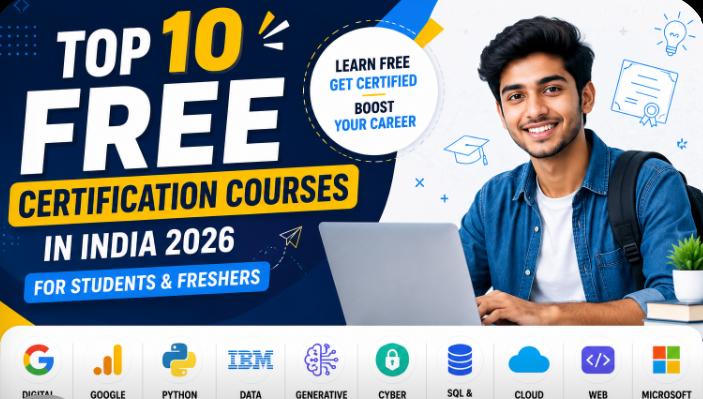
Top 10 Free Certification Courses in India 2026 for Students & Freshers
In this guide, we discuss the Top 10 Free Certification Courses in India in 2026 for college students, graduates, and freshers. These courses cover areas such as Artificial Intelligence, Digital Marketing, Data Analytics, Python, Cybersecurity, Cloud Computing, and Web Development.
Top 10 Free Certification Courses in India 2026 for Students & Freshers
Introduction
In today’s competitive job market, having a degree alone is often not enough to stand out. Employers increasingly look for practical skills, industry knowledge, and certifications that demonstrate a candidate’s willingness to learn.
The good news is that students and freshers do not always need to spend thousands of rupees to develop these skills. Several reputed platforms and technology companies provide free online courses and learning programs, and some also provide certificates either completely free or through specific free-certification offers.
In this guide, we discuss the Top 10 Free Certification Courses in India in 2026 for college students, graduates, and freshers. These courses cover areas such as Artificial Intelligence, Digital Marketing, Data Analytics, Python, Cybersecurity, Cloud Computing, and Web Development.
Why Should Students Take Free Certification Courses?
Free certification courses can provide several benefits:
Improve your resume and LinkedIn profile
Learn job-oriented skills
Build practical knowledge alongside your degree
Explore a career before paying for an expensive course
Prepare for internships and entry-level jobs
Create projects for your portfolio
Demonstrate continuous learning to employers
Understand new technologies such as AI and cloud computing
However, students should remember that a certificate alone does not guarantee a job. Skills, projects, internships, communication abilities, and interview preparation are equally important.
Top 10 Free Certification Courses in 2026
1. Google Digital Marketing & E-commerce
Digital marketing is one of the most popular career options for students from both technical and non-technical backgrounds.
Google provides learning resources covering important areas such as digital marketing, e-commerce, search engine optimization, social media, email marketing, and online advertising.
What You Can Learn
Digital marketing fundamentals
Search Engine Optimization
Search Engine Marketing
Social media marketing
Email marketing
E-commerce
Customer engagement
Digital advertising
Marketing analytics
Who Should Take This Course?
This course can be useful for:
BBA students
BCA students
MBA students
Commerce students
Freelancers
Aspiring digital marketers
Small-business owners
Career Options
After developing practical skills, students can explore roles such as:
Digital Marketing Executive
SEO Executive
Social Media Executive
Content Marketing Executive
E-commerce Executive
Performance Marketing Executive
2. Google Analytics Course
Data-driven decision-making has become extremely important for modern businesses.
Google Analytics learning resources can help beginners understand how websites and digital platforms are measured and analyzed.
Topics Covered
Website analytics
Traffic sources
User behavior
Events
Conversions
Reports
Audience analysis
Marketing performance
Why Learn Google Analytics?
For students interested in SEO, digital marketing, content marketing, or e-commerce, analytics knowledge can be extremely useful.
Career Opportunities
You can use these skills in roles such as:
SEO Executive
Digital Marketing Executive
Web Analyst
Marketing Analyst
E-commerce Analyst
3. Python Programming Course
Python is one of the most widely used programming languages and is particularly popular in:
Artificial Intelligence
Machine Learning
Data Science
Web Development
Automation
Data Analytics
Students can begin with free Python learning resources before investing in a paid program.
Topics to Learn
Python syntax
Variables
Data types
Conditional statements
Loops
Functions
Lists and dictionaries
Object-oriented programming
File handling
Exception handling
Basic projects
Who Should Learn Python?
Python is suitable for:
BCA students
B.Tech students
MCA students
Data Science beginners
AI/ML students
Automation enthusiasts
Career Scope
Python can help you prepare for roles such as:
Python Developer
Data Analyst
Automation Tester
Backend Developer
Data Scientist
Machine Learning Engineer
4. IBM Data Science Courses
Data Science is another high-demand technology field.
IBM provides several online learning resources related to data science, artificial intelligence, Python, databases, and data analysis.
Important Topics
Python
Data analysis
SQL
Data visualization
Statistics
Machine Learning
Jupyter Notebook
Data Science methodology
Who Should Consider Data Science?
Students interested in mathematics, programming, statistics, and analytical problem-solving can consider learning data science.
Career Options
Data Analyst
Data Scientist
Business Analyst
Machine Learning Engineer
Data Engineer
Tip: Don't stop after completing a certificate. Build at least 2–3 projects using real datasets.
5. Generative AI Courses
Generative AI has become one of the biggest technology trends in recent years.
Students can find free introductory courses and learning resources from major technology companies and educational platforms.
What Is Generative AI?
Generative AI refers to artificial intelligence systems that can create new content such as:
Text
Images
Audio
Video
Code
Topics Students Can Learn
Generative AI fundamentals
Large Language Models
Prompt engineering
AI applications
Responsible AI
AI productivity tools
AI-assisted programming
Career Scope
Generative AI knowledge can complement careers in:
Software development
Digital marketing
Content creation
Data analytics
Product management
Business operations
Important Advice
Students should not learn only how to use AI tools. They should also understand how AI works, its limitations, responsible use, and how to apply it to real-world problems.
6. Cybersecurity Fundamentals
Cybersecurity is becoming increasingly important as organizations move more of their operations online.
Beginners can start with free cybersecurity courses covering basic security concepts.
Topics Covered
Cybersecurity fundamentals
Network security
Password security
Authentication
Malware
Phishing
Security threats
Risk management
Basic security practices
Who Should Learn Cybersecurity?
This field is suitable for students interested in:
Computer networks
Ethical hacking
Information security
Cloud security
Digital forensics
Career Options
With additional practical training, students can target roles such as:
Cybersecurity Analyst
Security Analyst
SOC Analyst
Network Security Associate
Information Security Analyst
7. SQL and Database Management
SQL is one of the most useful technical skills for students interested in software development, data analytics, and databases.
SQL is used to communicate with relational databases and retrieve, modify, and analyze data.
SQL Topics to Learn
SELECT statements
WHERE conditions
ORDER BY
GROUP BY
JOIN
Subqueries
Aggregate functions
Database design
CRUD operations
Why Is SQL Important?
SQL is useful for:
Software developers
Data analysts
Business analysts
Data scientists
Backend developers
Database administrators
Beginner Project Idea
Create a simple College Student Management Database containing:
Student information
Courses
Attendance
Marks
Departments
This can become a useful portfolio project.
8. Cloud Computing Fundamentals
Cloud computing is now an essential part of modern IT infrastructure.
Students can begin with free introductory courses from major cloud providers.
Popular Cloud Platforms
Amazon Web Services
Microsoft Azure
Google Cloud
Topics to Learn
Cloud computing basics
Virtual machines
Storage
Databases
Networking
Security
Cloud deployment
Infrastructure fundamentals
Career Options
After gaining deeper knowledge and hands-on experience, students can pursue:
Cloud Support Associate
Cloud Engineer
Cloud Administrator
DevOps Engineer
Cloud Security Associate
Beginner Tip
Start with cloud fundamentals before jumping into advanced DevOps or cloud architecture.
9. Web Development Courses
Web development remains a popular career option for students and freshers.
Free online courses can help beginners learn how websites and web applications are created.
Frontend Technologies
HTML
CSS
JavaScript
Responsive Design
Bootstrap
Backend Technologies
Students can later learn technologies such as:
Python
Django
Node.js
PHP
Java
What Should Beginners Build?
Instead of only watching tutorials, create projects such as:
Personal portfolio website
Blog website
College management system
Online quiz application
E-commerce website
Student attendance system
Projects can be more valuable to your portfolio than collecting many certificates.
10. Microsoft Learn Courses
Microsoft Learn provides free learning resources covering a wide range of technology topics.
Students can explore areas such as:
Azure
AI
Data
Power Platform
Microsoft 365
Cybersecurity
Software development
Why Microsoft Learn?
The platform is particularly useful for students who want structured technical learning without immediately paying for a training program.
Popular Learning Areas
Azure Fundamentals
AI Fundamentals
Data Fundamentals
Power BI
Cloud Computing
Cybersecurity
Students can use Microsoft Learn to build foundational knowledge and prepare for relevant Microsoft certification exams.
Important: Learning content may be free, while some official certification exams may require payment. Always check the current certification requirements before assuming the exam itself is free.
Comparison of the Top 10 Free Courses
Course Area | Difficulty | Best For | Career Relevance |
|---|---|---|---|
Digital Marketing | Beginner | Marketing students | High |
Google Analytics | Beginner | SEO & Marketing | High |
Python | Beginner–Intermediate | IT Students | Very High |
Data Science | Intermediate | Technical Students | Very High |
Generative AI | Beginner–Intermediate | Almost Everyone | Very High |
Cybersecurity | Beginner–Intermediate | IT Students | Very High |
SQL | Beginner | Developers & Analysts | Very High |
Cloud Computing | Beginner | IT Students | Very High |
Web Development | Beginner–Intermediate | BCA/B.Tech/MCA | Very High |
Microsoft Learn | Beginner–Advanced | Technology Students | High |
How to Choose the Right Free Certification Course
Don't choose a course simply because the word "free" appears in its title.
Consider these factors:
1. Your Career Goal
If you want to become a developer, prioritize:
Python → SQL → Web Development → Git/GitHub → Projects
If you want to enter SEO or digital marketing:
Digital Marketing → SEO → Analytics → Content Marketing → Practical Projects
If you want an AI career:
Python → Statistics → Data Analysis → Machine Learning → Generative AI
If you want cybersecurity:
Networking → Linux → Cybersecurity Fundamentals → Security Tools → Practical Labs
2. Course Provider
Prefer courses offered by:
Universities
Government organizations
Recognized technology companies
Established educational platforms
Industry-recognized organizations
3. Certificate vs Skill
A certificate is evidence that you completed a learning activity.
A project demonstrates that you can actually use the skill.
For example:
Certificate + GitHub project + Internship > Certificate alone
How to Get the Maximum Benefit From Free Courses
Follow this simple strategy:
Step 1: Choose One Skill
Don't start five courses simultaneously.
Choose one skill based on your career goal.
Step 2: Complete the Course
Study consistently for 30–60 minutes every day.
Step 3: Make a Project
Immediately apply what you learned.
Step 4: Upload Your Work
Use platforms such as GitHub or create a portfolio website where appropriate.
Step 5: Add the Certificate to Your Resume
Mention:
Course name
Provider
Completion date
Relevant skills
Step 6: Apply for Internships
Once you have basic skills and projects, start applying for internships.
How Many Free Certificates Should a Student Have?
There is no magic number.
Having 20 certificates with no practical skills is generally less useful than having:
3–5 relevant certifications
2–4 strong projects
A good resume
A LinkedIn profile
GitHub/portfolio
Internship or practical experience
Focus on quality and relevance rather than quantity.
Are Free Online Certificates Valuable?
Yes, but their value depends on the provider, course content, and how you use the knowledge.
A certificate from a recognized organization can strengthen your resume, especially when you're a fresher.
However, employers may also evaluate:
Technical skills
Projects
Problem-solving
Communication
Internship experience
Interview performance
Therefore, don't rely on certificates alone.
Free Certification Courses vs Paid Courses
Factor | Free Courses | Paid Courses |
|---|---|---|
Cost | Usually low/free | Can be expensive |
Learning | Self-paced | Often structured |
Certificate | Depends on provider | Usually included |
Mentorship | Limited | Often available |
Projects | Depends on course | Usually more structured |
Placement | Usually not included | Some programs offer placement assistance |
Best For | Beginners | Structured career preparation |
Best Free Courses for Different Students
For BCA Students
Recommended learning path:
Python → SQL → Web Development → Git/GitHub → AI/ML basics
For B.Tech Students
Recommended path:
Programming → DSA → Cloud → AI/ML or Cybersecurity → Projects
For BBA Students
Recommended path:
Digital Marketing → Analytics → Excel → Business Analytics → AI tools
For Commerce Students
Recommended path:
Excel → Accounting Software → Analytics → Digital Marketing → Business Analytics
For MCA Students
Recommended path:
DSA → Python/Java → SQL → Web Development → Cloud/AI
Frequently Asked Questions
1. Which is the best free certification course in 2026?
There is no single best course for everyone. Python, Data Analytics, Generative AI, Cybersecurity, Cloud Computing, Digital Marketing, and Web Development are strong options depending on your career goal.
2. Can I get a job after completing a free certification course?
A certificate alone does not guarantee a job. You should combine the certification with practical projects, skills, internships, and interview preparation.
3. Are free online certificates useful for freshers?
Yes. They can demonstrate your interest in a particular field and help strengthen your resume, especially when combined with practical projects.
4. Which free course is best for BCA students?
Python, SQL, Web Development, Data Analytics, Cloud Computing, and Generative AI are excellent starting points for BCA students.
5. Which free course is best for non-technical students?
Digital Marketing, Google Analytics, Business Analytics, Excel, and Generative AI fundamentals can be good starting points.
6. Can I learn Python for free?
Yes. There are many free Python learning resources available online. Beginners should focus on fundamentals and then build projects.
7. Is a free certificate better than a paid certificate?
Not necessarily. The value depends on the provider, course quality, relevance, and whether you can demonstrate the skill practically.
8. How many certificates should I put on my resume?
Focus on relevant certificates rather than quantity. Around 3–5 strong, relevant certifications can be more useful than a long list of unrelated certificates.
9. Can students do multiple free courses?
Yes, but it is better to complete one course and apply the knowledge before starting another.
10. Which free course is best for an IT job?
Python, SQL, Web Development, Cloud Computing, Data Analytics, Cybersecurity, and AI-related courses can help students prepare for IT careers.
11. Is Generative AI useful for students?
Yes. Understanding Generative AI can improve productivity and complement skills in programming, marketing, data analysis, content creation, and many other fields.
12. Are certificates enough to get an internship?
No. Companies may also evaluate your technical skills, projects, resume, communication, and interview performance.
13. Can I add free certificates to LinkedIn?
Yes. If the certificate is legitimate and issued by a recognized provider, you can add it to your LinkedIn Licenses & Certifications section.
14. Which course is best for a high-paying career?
AI/ML, data science, cybersecurity, cloud computing, software development, and specialized technology fields can offer strong earning potential, but salary depends on skills, experience, company, location, and role.
15. Should I choose a certificate or build projects?
Ideally, do both. Use the course to learn the skill and the project to demonstrate that you can apply it.
Conclusion
Free certification courses can be an excellent starting point for students and freshers who want to develop job-oriented skills without spending a large amount of money.
The most important thing is not the number of certificates you collect. Instead, focus on learning useful skills, building projects, gaining practical experience, and continuously improving your resume.
If you are confused about where to start, choose one career path and follow it consistently.
For example:
BCA Student → Python → SQL → Web Development → Projects → Internship → IT Job
or
Non-Technical Student → Digital Marketing → SEO → Analytics → Projects → Internship
Start with one free course today, complete it properly, build something with what you learned, and then move to the next skill.
Remember: Certificates can open the door, but skills and practical experience help you get through it.
Extra pointers for Indian readers
The guide above stays the main reference. The table and questions below help you act on it – compare providers, confirm fees, and search locally when you are ready.
At a glance
| Step | When | Your action |
|---|---|---|
| Define needs | Day 1 | Write must-haves, budget, location |
| Shortlist 3 providers | Day 1–2 | Search by city; save numbers |
| Compare quotes | Day 2–3 | Same questions to each provider |
| Verify details | Before paying | Call to confirm slot and scope |
| Book & confirm | Once satisfied | Written confirmation on chat/email |
| After service | Same week | Note what worked for next time |
Figures and timelines vary by city and provider — use this table for planning, not as a price guarantee.
When in doubt, choose the provider who answers plainly over the one who overpromises.
Quick answers before you book
Is Top 10 Free Certification Courses in India 2026 for Students & Freshers different in metro cities and smaller towns?
Usually yes. Availability, pricing, and travel charges shift between metros and tier-2 cities. Filter by your city or locality, then confirm service area on a quick phone call before you pay.
How do I know if a listing for in this guide, we discuss the top 10 free certification courses in india in 2026 is still active?
Treat online hours as a hint. Call or WhatsApp the number on the listing, ask if they take new bookings this week, and note who you spoke with. That single step prevents many wasted trips.
What should I prepare before contacting providers about in this guide, we discuss the top 10 free certification courses in india in 2026?
Have your location landmark, preferred date or time window, budget range, and any must-haves written down. Providers answer faster when your brief is specific instead of "how much?" alone.
How local is "near me" in practice?
Search tools use city and locality pins, but providers may still charge travel outside a radius. Confirm they serve your pincode or landmark before scheduling.
Is the cheapest quote always the best deal?
Rarely. Lower quotes may exclude tax, travel, materials, or cleanup. Compare line items and ask what happens if the job runs long or needs a return visit.
Do prices for in this guide, we discuss the top 10 free certification courses in india in 2026 include GST?
Not always on the first quote. Ask whether GST is extra, whether you need a formal invoice, and what name will appear on the bill – especially for business reimbursements.
Does it matter which city I search from (e.g. Hyderabad)?
Yes. Start with your actual city or locality filter. A great provider in another city is irrelevant if they will not travel to you without heavy surcharges.
Can I pay in cash or UPI – what is safer?
UPI with a note in WhatsApp is common and leaves a trail. For large event or renovation payments, staged transfers tied to milestones reduce risk for both sides.
How do I report outdated information on a listing?
Use contact options on VedList Discover or reach support if something looks wrong. Owners can also claim listings to correct phone numbers and hours directly.
Should I call or WhatsApp first?
WhatsApp lets you share location pins and photos; calls resolve urgent timing faster. Try the channel the listing promotes, then switch if nobody responds within a reasonable window.