
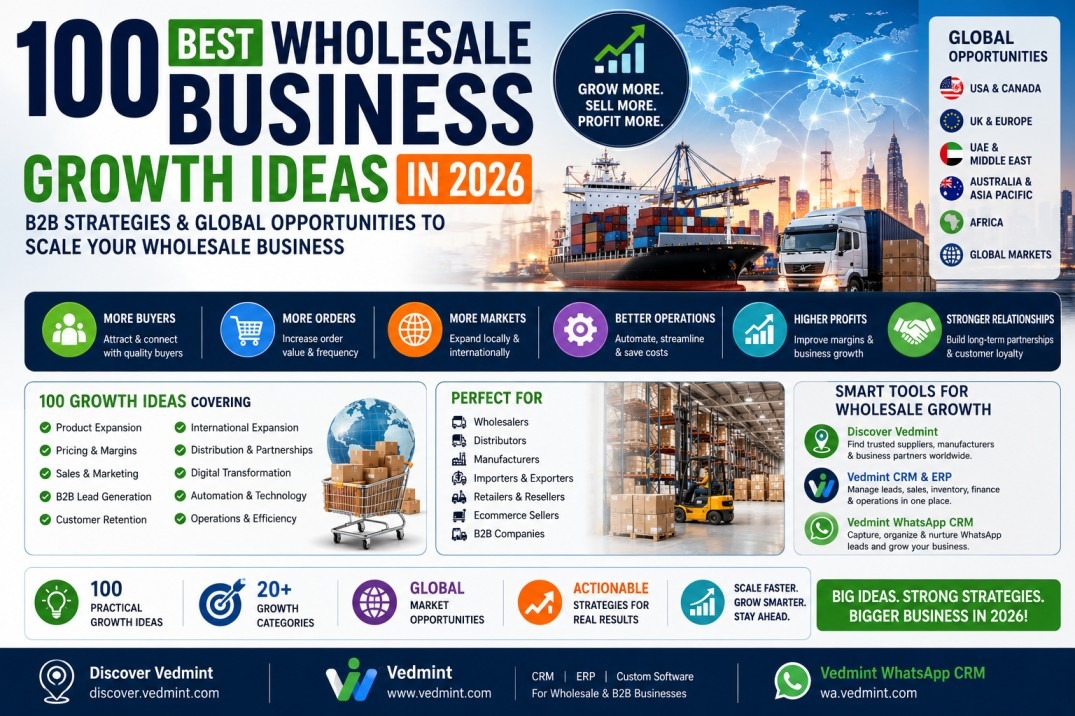
100 Best Wholesale Business Growth Ideas : B2B Strategies & Global Opportunities
Discover 100 powerful wholesale business growth ideas for 2026. Learn how to increase B2B sales, find more buyers, expand globally, improve margins, automate operations and scale your wholesale business.
100 Best Wholesale Business Growth Ideas in 2026: Products, B2B Strategies & Global Opportunities to Scale Your Business
Growing a wholesale business in 2026 requires more than finding more products and offering lower prices.
Wholesale businesses today compete on:
Product availability
Pricing
Supplier relationships
Distribution
Customer experience
Technology
Speed
Inventory management
B2B marketing
International reach
Sales follow-up
Whether you operate a wholesale company, distribution business, manufacturing company, import-export business, ecommerce operation, retail network, or B2B supply company, there are multiple ways to expand.
The biggest opportunity is often not starting another business.
It is finding ways to make your existing business bigger, more efficient, and easier for buyers to discover.
This comprehensive guide explores 100 wholesale business growth ideas for 2026, covering product expansion, B2B sales, international markets, digital marketing, automation, CRM, ecommerce, distribution, and customer retention.
Businesses can also explore companies, suppliers, manufacturers, distributors, and service providers through Discover Vedmint at discover.vedmint.com.
How to Grow a Wholesale Business in 2026
If you already operate a wholesale or B2B business, focus on seven major growth engines:
More Products → More Buyers → More Markets → Bigger Orders → Higher Repeat Purchases → Better Margins → Better Operations
A business does not necessarily need all seven simultaneously.
For example, a wholesaler could grow revenue by keeping the same products but acquiring more retailers.
Another could keep the same customers while increasing average order value.
Another could expand internationally.
Another could increase profitability by improving procurement.
Before pursuing growth, understand where your biggest opportunity exists.
1. Add Complementary Products
One of the simplest ways to grow is selling additional products to existing customers.
Suppose you wholesale mobile accessories.
Instead of supplying only phone covers, you could expand into:
Chargers
Cables
Screen protectors
Holders
Power accessories
You already have the buyer relationship.
That can make cross-selling easier than acquiring an entirely new customer.
2. Create Product Bundles
Combine related products into B2B packages.
For example:
Restaurant Starter Package
could contain:
Disposable containers
Paper bags
Tissues
Cups
Cleaning supplies
Bundles can increase average order value while simplifying procurement for buyers.
3. Introduce Premium Product Lines
Not every buyer wants the cheapest product.
Some customers prioritize:
Better materials
Better finishing
Premium packaging
Better durability
Brand perception
Adding premium options can improve margins without abandoning price-sensitive customers.
4. Add Budget Product Lines
The opposite strategy can also work.
If your current products target premium customers, introduce a value range for:
Smaller retailers
Discount stores
New businesses
Price-sensitive markets
Segment the products clearly so the lower-priced range does not unnecessarily weaken your premium positioning.
5. Develop Private-Label Products
Private labeling can create stronger differentiation.
Instead of selling the same generic products as every competitor, develop products under your own brand.
Potential categories include:
Food
Cosmetics
Clothing
Home products
Cleaning products
Office products
Accessories
Private labeling requires appropriate quality, branding, compliance, and supply-chain management.
6. Offer Private Label Manufacturing to Buyers
If you manufacture products, let retailers and other businesses sell them under their own brands.
This can open another B2B revenue stream.
Provide clear information about:
MOQ
Customization
Packaging
Labeling
Production lead time
Samples
7. Develop Exclusive Products
Work with manufacturers to create products competitors cannot easily source.
Exclusivity can come from:
Design
Materials
Features
Packaging
Distribution rights
Territory agreements
Make sure exclusivity arrangements are documented appropriately.
8. Expand Your Product Catalogue
Wholesale buyers often prefer suppliers who can consolidate procurement.
If you sell 50 products while a competitor offers 500 relevant products, buyers may find the competitor more convenient.
Expand intelligently.
Do not add random products simply to make your catalogue bigger.
9. Remove Low-Performing Products
Growth does not always mean adding more.
Some products consume:
Warehouse space
Working capital
Staff time
without generating adequate profit.
Analyze SKU-level performance and discontinue products that consistently fail to justify their cost.
10. Identify Your Most Profitable Products
Your highest-revenue product may not be your most profitable.
Calculate contribution after relevant costs such as:
Product cost
Freight
Storage
Packaging
Returns
Sales commissions
Then prioritize products with strong economics and sustainable demand.
11. Increase Average Order Value
Suppose your average B2B order is $1,000.
Increasing it to $1,200 without acquiring additional customers creates substantial growth.
Strategies include:
Quantity discounts
Bundles
Cross-selling
Minimum order thresholds
Free-shipping thresholds where economically sensible
12. Introduce Volume Pricing
Create clear quantity tiers.
Example:
100–499 units: Standard wholesale price
500–999 units: Lower unit price
1,000+ units: Volume price
Design tiers around your actual margins rather than arbitrary discounts.
13. Introduce Minimum Order Values
Very small orders can become expensive to process.
A minimum order value can improve:
Warehouse efficiency
Shipping economics
Sales productivity
But setting it too high may exclude valuable smaller customers.
Test carefully.
14. Create Loyalty Pricing
Long-term buyers can receive benefits based on:
Annual purchasing
Order frequency
Payment history
Volume
The goal is to reward valuable relationships rather than giving every customer the same discount.
15. Create a VIP Buyer Program
Your top customers may deserve differentiated service.
Possible benefits:
Dedicated account manager
Priority stock allocation
Early access to products
Faster support
Special commercial terms
A small number of customers may contribute a large percentage of wholesale revenue.
Protect those relationships.
16. Build a B2B Ecommerce Website
Wholesale buyers increasingly expect online convenience.
A B2B website can allow customers to:
Browse products
View specifications
Request quotations
Place orders
Download catalogues
Contact sales
For complex wholesale pricing, the website can support quotation requests rather than publishing every price.
17. Create Individual Product Pages
Do not put your entire catalogue inside one PDF.
Create searchable web pages for important products.
Each page can include:
Product name
Images
Specifications
MOQ
Packaging
Applications
Available variants
Contact or RFQ option
This can also improve search visibility.
18. Optimize for B2B SEO
Potential customers search phrases such as:
“wholesale packaging supplier”
“garment wholesaler”
“office furniture supplier”
“bulk food distributor”
“industrial equipment supplier”
Identify the exact searches your buyers make and create useful pages around them.
19. Target Product + Supplier Keywords
If you sell LED lights, target terms such as:
LED light supplier
LED light wholesale supplier
commercial LED supplier
bulk LED lights
Search intent matters more than simply targeting huge search-volume keywords.
20. Target Product + Location Keywords
Local and regional B2B searches can be highly valuable.
Examples:
packaging supplier in Dubai
garment wholesaler in London
food distributor in New York
Create location pages only for markets you genuinely serve and provide useful local information.
21. Target “Near Me” B2B Searches
Some business buyers search locally.
Examples:
wholesale suppliers near me
packaging supplier near me
food distributor near me
office furniture wholesaler near me
B2B suppliers near me
Maintain accurate location and service-area information.
22. Build an Online Business Profile
Potential buyers may research your business before contacting you.
A strong profile should communicate:
Company name
Products
Industries
Location
Service areas
Contact information
Images
Capabilities
Businesses can explore listing and discovery opportunities through Discover Vedmint at discover.vedmint.com.
23. Publish a Digital Catalogue
A professional digital catalogue can help sales teams share products quickly.
Include:
Clear product names
Good images
Specifications
Product codes
Packaging
MOQ where appropriate
Keep it updated.
An outdated catalogue creates confusion.
24. Add RFQ Forms
B2B buyers often need custom quotations.
Create a Request for Quotation form asking for useful information such as:
Product
Quantity
Destination
Required specifications
Timeline
Contact details
This helps sales teams qualify opportunities faster.
25. Improve Website Conversion Rate
Traffic without enquiries does not produce sales.
Your website should make the next action obvious.
Examples:
Request Quote
Get Wholesale Price
Download Catalogue
Talk to Sales
Become a Distributor
Measure which calls to action produce qualified leads.
26. Create Dedicated Landing Pages
Instead of sending every advertisement to your homepage, create focused landing pages.
For example:
Bulk Packaging Supplies for Restaurants
is more relevant to restaurant buyers than a generic corporate homepage.
27. Create Industry-Specific Pages
If your products serve several industries, create pages for each major audience.
For example:
Packaging for Ecommerce
Packaging for Restaurants
Packaging for Cosmetics
Packaging for Pharmaceuticals
Different buyers have different requirements.
28. Publish Buyer Guides
Educational content can attract buyers before they are ready to request a quote.
Examples:
How to choose packaging materials
How to calculate wholesale MOQ
How to evaluate suppliers
How to reduce procurement costs
Useful content can become an acquisition channel.
29. Build Topic Clusters
Instead of publishing random blog posts, build clusters.
For a wholesale packaging company:
Pillar: Complete Packaging Buying Guide
Supporting articles:
Corrugated boxes
Food packaging
Ecommerce packaging
Custom packaging
Packaging costs
Packaging materials
Link related pages together.
30. Build International SEO Pages
If you genuinely sell internationally, create useful pages for priority markets.
Examples:
Wholesale Suppliers for USA Buyers
Wholesale Suppliers for UAE Buyers
Wholesale Suppliers for UK Buyers
Wholesale Suppliers for Australian Buyers
Avoid copying the same content and replacing only the country name.
31. Expand into New Cities
Before expanding nationally or internationally, identify underserved cities in your existing market.
Evaluate:
Demand
Competition
Shipping costs
Buyer concentration
Local sales opportunities
32. Expand into New States or Regions
Regional expansion can be less risky than immediately entering another country.
Use existing logistics infrastructure where possible.
33. Expand Internationally
International buyers can dramatically increase the addressable market.
But exporting introduces:
Customs
Compliance
Shipping
Currency
Payment
Documentation
Regulatory risks
Start with markets where your product has a clear advantage.
34. Target USA Buyers
The U.S. offers a huge B2B market across:
Retail
Ecommerce
Food
Hospitality
Construction
Manufacturing
Corporate procurement
Research product-specific import requirements before selling.
35. Target Canadian Buyers
Canada can offer opportunities for international suppliers, particularly when products meet applicable Canadian standards and labeling requirements.
36. Target UK Buyers
The UK has extensive retail, ecommerce, hospitality, industrial, and distribution markets.
Provide clear landed-cost and delivery information where possible.
37. Target European Buyers
Europe is not one homogeneous market.
Research individual countries and applicable EU requirements.
Potential markets include:
Germany
France
Netherlands
Italy
Spain
Poland
Sweden
38. Target UAE Buyers
The UAE can serve both as an end market and a regional commercial hub.
Potential opportunities include:
Food
Building materials
Furniture
Fashion
Hospitality products
Corporate supplies
Technology
39. Target Saudi Arabia
Saudi Arabia has substantial demand across construction, hospitality, retail, food, technology, and industrial categories.
Understand local import and product requirements.
40. Target Australian Buyers
Australian buyers may value differentiated products, reliable supply, and clear communication.
Pay close attention to biosecurity and product-specific import rules.
41. Target African Markets
Africa contains many distinct markets rather than one single opportunity.
Evaluate countries individually based on:
Demand
Purchasing power
Logistics
Regulation
Distribution networks
42. Find Local Distributors
Instead of selling directly to thousands of customers in a new market, partner with established distributors.
A distributor may already have:
Retail relationships
Warehousing
Sales teams
Local knowledge
43. Recruit Dealers
Dealer networks can help expand geographically without opening your own locations everywhere.
Create a clear dealer proposition covering:
Margins
Territory
Minimum purchases
Marketing support
Training
Sales targets
44. Create a Distributor Program
Professionalize distributor recruitment.
Create a page titled:
Become Our Distributor
Explain:
Products
Markets
Requirements
Support
Application process
This can generate inbound partnership enquiries.
45. Build Strategic Partnerships
Partner with businesses serving the same customers without directly competing.
A packaging supplier could partner with:
Printers
Ecommerce agencies
Fulfilment companies
Food consultants
Partnerships can become recurring lead sources.
46. Attend Trade Shows
Trade shows remain valuable in many B2B industries.
Use them for:
Lead generation
Distributor recruitment
Supplier discovery
Competitor research
Product launches
The real value often comes from follow-up after the event.
47. Improve Trade Show Follow-Up
Do not collect hundreds of business cards and forget them.
After the event:
Add leads to CRM.
Categorize them.
Send relevant information.
Schedule follow-ups.
Track opportunities.
48. Use LinkedIn for B2B Sales
LinkedIn can help identify:
Procurement managers
Business owners
Distributors
Retail buyers
Importers
Category managers
Avoid generic spam.
Research the prospect and explain why your offer is relevant.
49. Build a Founder/Executive Presence
B2B buyers often trust people before brands.
Business leaders can publish insights about:
Industry trends
Product knowledge
Supply chains
Manufacturing
Procurement
Customer success
This can strengthen authority.
50. Use Email Marketing
Email remains useful for B2B relationships.
Send useful communications such as:
New products
Restocked products
Price updates
Industry insights
Seasonal catalogues
Special buying opportunities
Do not overwhelm buyers with irrelevant promotions.
51. Segment Your Email Database
A restaurant buyer should not necessarily receive the same campaign as an industrial buyer.
Segment customers based on:
Industry
Products
Location
Purchase history
Order size
Engagement
Relevance improves performance.
52. Use WhatsApp for Buyer Communication
In markets where WhatsApp is commonly used for business, it can help with:
Product enquiries
Catalogue sharing
Quotation discussions
Follow-ups
Order updates
As message volume grows, manual management becomes difficult.
Businesses can explore Vedmint WhatsApp CRM at wa.vedmint.com.
53. Centralize Leads in a CRM
Your leads may arrive from:
Website
WhatsApp
Email
Social media
Trade shows
Business listings
Referrals
If each channel is managed separately, opportunities can disappear.
A CRM creates a central sales process.
54. Build a Sales Pipeline
Create stages such as:
New Lead → Qualified → Quote Sent → Negotiation → Sample/Trial → Won/Lost
This helps management understand where revenue opportunities are sitting.
55. Automate Sales Follow-Ups
Salespeople forget.
Systems do not have to.
Use CRM automation to remind teams when:
A quotation needs follow-up
A buyer has not responded
A repeat order may be due
A contract is approaching renewal
56. Measure Lead Response Time
How long does your business take to answer an enquiry?
Five minutes?
Two hours?
Two days?
For competitive product categories, slow responses can cost opportunities.
Measure response time and improve it.
57. Create Lead Assignment Rules
If you have multiple salespeople, define who receives each lead.
Assignment can be based on:
Territory
Product
Industry
Customer size
Language
Clear ownership reduces missed enquiries.
58. Track Lead Sources
Know which channels actually produce customers.
Track sources such as:
Organic search
Paid ads
Discover Vedmint
LinkedIn
WhatsApp
Trade shows
Referrals
Then invest more in channels producing profitable customers.
59. Track Quote-to-Order Conversion
If you send 100 quotations and only two become orders, something may be wrong.
Investigate:
Pricing
Lead quality
Response time
Product fit
Follow-up
Payment terms
60. Analyze Lost Deals
Ask why opportunities were lost.
Common reasons include:
Price
MOQ
Delivery
Quality concerns
Missing products
Competitor relationships
Slow response
Lost deals contain valuable market intelligence.
61. Create a Repeat-Order System
Wholesale businesses often grow fastest through repeat buyers.
Track normal reorder cycles.
If a retailer usually orders every 30 days, contact them before the expected reorder date.
62. Automate Reorder Reminders
CRM or ERP systems can identify customers likely to need replenishment.
This turns reactive selling into proactive account management.
63. Improve Customer Retention
Acquiring customers can be expensive.
Protect the buyers you already have.
Improve:
Product consistency
Communication
Delivery reliability
Problem resolution
Account management
64. Calculate Customer Lifetime Value
A buyer placing one $2,000 order is useful.
A buyer placing $2,000 orders every month for five years is far more valuable.
Evaluate customers based on long-term economics rather than only their first transaction.
65. Create Account Growth Plans
For important buyers, identify:
Current products purchased
Products not yet purchased
Potential order growth
New locations
Upcoming requirements
Treat major accounts strategically.
66. Cross-Sell Existing Customers
If a customer buys packaging boxes, they may also need:
Tape
Labels
Protective material
Bags
Printing
Cross-selling can increase revenue without acquiring a new customer.
67. Upsell Better Products
Offer higher-value alternatives when they genuinely improve the customer's outcome.
Do not upsell simply to increase the invoice.
68. Reduce Customer Churn
Track customers who suddenly stop ordering.
Contact them.
Maybe they:
Changed supplier
Had a service issue
Found a lower price
Changed business direction
Some customers can be recovered.
69. Improve Inventory Forecasting
Running out of a best-selling product can mean lost sales.
Holding too much slow-moving inventory locks up cash.
Use sales history and demand patterns to improve purchasing.
70. Classify Inventory
Group products based on importance.
For example:
A: High-value/high-impact SKUs
B: Medium importance
C: Lower-value products
Management attention should reflect economic importance.
71. Identify Dead Stock
Dead stock consumes warehouse space and working capital.
Consider:
Bundling
Clearance
Alternative channels
Supplier returns where permitted
Prevent future dead stock by improving purchasing decisions.
72. Improve Warehouse Management
Warehouse efficiency affects profitability.
Optimize:
Product placement
Picking routes
Receiving
Packing
Dispatch
Stock counts
Small improvements compound at scale.
73. Introduce Barcode Systems
Barcodes can improve inventory accuracy and reduce manual errors.
74. Implement ERP
As operations become more complex, disconnected spreadsheets become difficult to manage.
ERP can integrate:
Sales
Inventory
Purchases
Finance
Operations
Businesses can explore ERP and custom technology solutions through Vedmint at www.vedmint.com.
75. Connect CRM and ERP
CRM manages the sales relationship.
ERP manages much of the operational transaction flow.
Connecting the two can create a smoother process:
Lead → Quote → Order → Inventory → Invoice → Delivery → Repeat Sale
76. Automate Quotations
For standardized products, quotation tools can reduce manual work.
Sales teams can respond faster while maintaining consistent pricing rules.
77. Digitize Order Processing
Reduce manual copying between:
WhatsApp
Email
Spreadsheets
Inventory systems
Accounting systems
Repeated manual data entry creates errors.
78. Automate Customer Notifications
Automatically send relevant updates such as:
Order confirmed
Order dispatched
Payment received
Delivery scheduled
Keep communication useful rather than excessive.
79. Improve Procurement
Wholesale profitability starts with buying.
Evaluate suppliers based on:
Price
Quality
Lead time
Reliability
Payment terms
Defect rate
Do not optimize procurement solely for the lowest purchase price.
80. Negotiate Better Supplier Terms
As your purchasing volume grows, negotiate:
Pricing
Payment terms
MOQ
Delivery
Packaging
Exclusivity
Strong supplier relationships can become a competitive advantage.
81. Develop Backup Suppliers
Depending entirely on one supplier creates risk.
Develop qualified alternatives for critical products.
82. Consolidate Purchases
Larger planned orders can sometimes improve:
Pricing
Freight
Negotiation power
But avoid buying excess inventory merely to obtain a lower unit price.
83. Reduce Freight Costs
Analyze:
Carrier rates
Shipment consolidation
Packaging dimensions
Routes
Delivery frequency
Freight savings can materially improve wholesale margins.
84. Optimize Packaging for Logistics
Oversized packaging increases shipping and storage costs.
Design packaging that protects products without unnecessary volume.
85. Measure Gross Margin by Product
Do not treat every SKU equally.
Identify products that generate:
High revenue and high margin
High revenue and low margin
Low revenue and high margin
Low revenue and low margin
This can guide pricing and inventory decisions.
86. Measure Profitability by Customer
A large customer may look attractive but could demand:
Heavy discounts
Long payment terms
Frequent returns
Expensive delivery
Extensive support
Calculate actual account profitability.
87. Review Your Pricing Strategy
Prices should reflect:
Product cost
Operating costs
Market conditions
Customer value
Volume
Competition
Desired margin
Do not leave prices unchanged indefinitely while costs change.
88. Introduce Dynamic Commercial Terms
Different buyers may receive different terms based on:
Volume
Relationship
Payment history
Contract
Geography
Create clear policies to maintain consistency.
89. Improve Cash Flow
A profitable company can still struggle if cash is trapped in:
Inventory
Receivables
Slow-moving products
Monitor cash conversion closely.
90. Reduce Late Payments
Create clear:
Credit policies
Payment terms
Reminders
Escalation processes
Extend credit based on appropriate business assessment rather than habit.
91. Use Data for Decision-Making
Track key metrics such as:
Revenue
Gross margin
Average order value
Repeat purchase rate
Inventory turnover
Lead conversion
Customer acquisition cost
Customer lifetime value
Order frequency
What gets measured becomes easier to improve.
92. Build Sales Dashboards
Management should quickly understand:
New leads
Open quotations
Pipeline value
Sales by representative
Sales by product
Sales by region
Lost opportunities
Avoid waiting until month-end to discover problems.
93. Use AI for Repetitive Business Tasks
AI can assist with tasks such as:
Product descriptions
Lead classification
Customer-support drafts
Data analysis
Internal knowledge search
Sales summaries
Keep appropriate human oversight, especially for pricing, contracts, financial decisions, and customer commitments.
94. Improve Customer Support
Wholesale customers can have urgent problems.
A missing shipment or incorrect order can affect their own customers.
Provide clear escalation paths and resolve problems quickly.
95. Collect Customer Feedback
Ask customers:
Which products are missing?
What causes ordering friction?
Why do they buy from competitors?
What could improve delivery?
Customers can reveal growth opportunities that internal teams miss.
96. Launch a Referral Program
Satisfied B2B customers may know other businesses in the same industry.
Create appropriate referral incentives or partnership arrangements where suitable.
97. Build a Recognizable B2B Brand
Wholesale companies often underinvest in branding.
Professional:
Website
Catalogue
Packaging
Communication
Sales documents
Digital presence
can make your company easier to trust and remember.
98. Get Your Business Discovered Online
Even a great supplier cannot win business if buyers cannot find it.
Strengthen your presence across:
Search engines
Business discovery platforms
Industry directories
Social networks
Relevant marketplaces
Businesses can explore discovery opportunities through Discover Vedmint at discover.vedmint.com.
99. Build an Integrated B2B Technology Stack
A growing wholesale business may eventually need:
Website + CRM + WhatsApp + ERP + Analytics + Automation
The goal is not collecting software.
The goal is creating a connected customer journey.
Businesses can explore CRM, ERP, automation, and custom software solutions through Vedmint at www.vedmint.com.
100. Turn Every Enquiry into a Managed Opportunity
This may be the most important growth strategy on the list.
Imagine your business receives 1,000 enquiries per month.
If 300 are never followed up properly, buying more advertising may not be the best first move.
Improve the system.
Every qualified enquiry should have:
Owner
Status
Next action
Follow-up date
Conversation history
Outcome
This is where structured CRM and WhatsApp lead management can make a significant difference.
Businesses handling large numbers of WhatsApp enquiries can explore Vedmint WhatsApp CRM at wa.vedmint.com.
20 High-Potential Wholesale Categories for 2026
Businesses looking to expand their catalogues can research categories such as:
Packaging supplies
Clothing and textiles
Beauty and personal care
Food products
Home and kitchen products
Office supplies
Furniture
Electronics accessories
Automotive accessories
Construction materials
Industrial supplies
Hospitality supplies
Restaurant supplies
Cleaning supplies
Pet products
Sports products
Corporate gifts
Ecommerce packaging
Sustainable products
Private-label consumer products
Demand, competition, regulation, and margins vary significantly by country and category.
Research the specific market before expanding.
Wholesale Growth Strategy for USA
For U.S. expansion, focus on:
Market demand
Product compliance
Reliable fulfilment
Competitive landed cost
B2B SEO
Distributor relationships
Do not enter the entire United States simultaneously if your resources are limited.
Start with a well-defined customer segment.
Wholesale Growth Strategy for UK & Europe
Consider:
Product regulations
VAT/tax implications
Localization
Distribution
Packaging
Sustainability expectations
Europe contains multiple distinct markets.
Country-specific research matters.
Wholesale Growth Strategy for UAE & Middle East
Potential growth channels include:
Distributor partnerships
Hospitality
Retail
Construction
Food service
Ecommerce
Corporate procurement
Local relationships can be particularly valuable.
Wholesale Growth Strategy for Asia-Pacific
Markets such as Australia, Singapore, Japan, and other Asia-Pacific economies can offer opportunities depending on product category.
Evaluate each market independently.
How Discover Vedmint Can Help B2B Businesses
Wholesale businesses need visibility.
Potential buyers may search for:
Suppliers
Manufacturers
Wholesalers
Distributors
Service providers
Business partners
Discover Vedmint can provide another channel for businesses to establish their online presence and become discoverable.
Explore:
How Vedmint Can Help Growing Businesses
Growth creates operational complexity.
Businesses may need better systems for:
Leads
Customers
Sales
Inventory
Operations
Automation
Reporting
Vedmint provides business technology solutions including CRM, ERP, and custom software development.
Explore:
Manage Wholesale Leads with Vedmint WhatsApp CRM
If buyers frequently contact your company through WhatsApp, important conversations can become difficult to manage as the business grows.
Potential buyer messages include:
“Send wholesale price.”
“What is your MOQ?”
“Need 5,000 units.”
“Send catalogue.”
“Do you ship internationally?”
“Can I become a distributor?”
Each can represent a potential sale.
Vedmint WhatsApp CRM can help businesses organize WhatsApp-based leads and customer conversations.
Explore:
Frequently Asked Questions
1. How can I grow my wholesale business in 2026?
Focus on acquiring more qualified buyers, increasing repeat orders, expanding products and markets, improving margins, and strengthening operations.
2. How do wholesalers get more customers?
Use SEO, referrals, direct sales, business listings, trade shows, partnerships, email, LinkedIn, and other relevant B2B channels.
3. How can I increase wholesale sales?
Increase buyer acquisition, conversion rate, order value, purchase frequency, and customer retention.
4. How can I get B2B leads?
Create useful product pages, improve search visibility, build business profiles, attend industry events, use professional outreach, and encourage referrals.
5. Should wholesalers sell online?
For many industries, yes. Even when transactions happen offline, buyers often research suppliers online first.
6. Do wholesalers need a website?
A professional website can help buyers evaluate products and contact the company.
7. What should a wholesale website contain?
Include products, specifications, company information, service areas, contact details, catalogue access, and RFQ options.
8. Should I show wholesale prices online?
It depends on your pricing model. Some businesses publish prices while others require quotations.
9. What is MOQ?
MOQ means Minimum Order Quantity.
10. Should I reduce MOQ?
Only when the economics and operational impact make sense.
11. How do I increase average order value?
Use bundles, cross-selling, quantity tiers, complementary products, and relevant upselling.
12. How can I get repeat wholesale orders?
Deliver consistently, maintain communication, monitor reorder cycles, and proactively follow up.
13. What is B2B SEO?
B2B SEO is the process of improving organic search visibility for searches made by potential business customers.
14. What keywords should wholesalers target?
Target product + wholesale, product + supplier, product + distributor, bulk product, and relevant location terms.
15. Should wholesalers target “near me” searches?
Yes, when local buyers are important to the business.
16. How can I expand internationally?
Research markets, regulations, logistics, pricing, demand, and distribution before entering.
17. Which country is best for wholesale expansion?
There is no universal best market. The answer depends on product demand, competition, regulations, logistics, and economics.
18. How do I find distributors?
Use industry networks, trade shows, direct outreach, search, partnerships, and distributor-recruitment pages.
19. Should I create a dealer network?
A dealer network can be effective for products requiring local sales or distribution.
20. How can I recruit dealers online?
Create a clear “Become a Dealer” page and promote it through relevant B2B channels.
21. Is LinkedIn useful for wholesale businesses?
Yes, particularly for identifying decision-makers and building professional relationships.
22. Is email marketing useful for B2B?
Yes, when campaigns are relevant, permission-aware, and properly segmented.
23. Can WhatsApp help wholesale businesses?
In markets where buyers commonly use WhatsApp, it can be an effective communication channel.
24. What is WhatsApp CRM?
It helps organize customer and sales conversations associated with WhatsApp.
25. Does Vedmint offer WhatsApp CRM?
Businesses can explore Vedmint WhatsApp CRM at wa.vedmint.com.
26. What is CRM?
CRM stands for Customer Relationship Management.
27. Why do wholesalers need CRM?
CRM can help organize leads, buyers, quotations, follow-ups, and sales opportunities.
28. Does Vedmint provide CRM?
Businesses can explore Vedmint's CRM and technology solutions at www.vedmint.com.
29. What is ERP?
ERP stands for Enterprise Resource Planning.
30. Why do wholesalers need ERP?
ERP can help integrate sales, inventory, purchases, finance, and operations.
31. Does Vedmint provide ERP solutions?
Businesses can explore Vedmint's ERP-related solutions at www.vedmint.com.
32. Should CRM and ERP be connected?
Integration can reduce duplicate work and improve visibility across sales and operations.
33. How do I manage thousands of products?
Use appropriate inventory and ERP systems with consistent SKU structures and product data.
34. How can I reduce dead stock?
Improve forecasting, monitor slow-moving SKUs, and use controlled clearance or bundling strategies.
35. How do I improve inventory turnover?
Purchase more accurately, reduce slow-moving stock, and improve sales of appropriate inventory.
36. What is inventory turnover?
It measures how frequently inventory is sold and replaced during a period.
37. How can I improve wholesale margins?
Improve procurement, pricing, product mix, freight, operational efficiency, and customer profitability.
38. Should I always negotiate lower supplier prices?
Price matters, but quality, reliability, lead time, and payment terms also create value.
39. Should I have multiple suppliers?
Backup suppliers can reduce supply-chain risk for critical products.
40. How can I reduce shipping costs?
Optimize packaging, carriers, shipment consolidation, routes, and warehouse locations.
41. Should I offer free shipping?
Only if the economics support it. You can use minimum order thresholds when appropriate.
42. How can I improve cash flow?
Manage inventory, receivables, supplier terms, purchasing, and payment collection.
43. Should I offer credit to B2B customers?
Credit decisions should be based on appropriate risk assessment and clear commercial policies.
44. How do I reduce late payments?
Use clear terms, reminders, credit limits, and escalation procedures.
45. What metrics should a wholesaler track?
Revenue, gross margin, average order value, repeat rate, inventory turnover, conversion rate, customer lifetime value, and cash flow are useful starting points.
46. What is average order value?
It is the average value of customer orders over a defined period.
47. What is customer lifetime value?
It estimates the economic value of a customer relationship over time.
48. How can I increase customer lifetime value?
Improve retention, cross-selling, order frequency, customer experience, and relevant product expansion.
49. What is lead conversion rate?
It measures the percentage of leads that become customers or reach another defined conversion event.
50. How do I improve lead conversion?
Improve lead quality, response time, qualification, quotations, follow-ups, and sales execution.
51. Why do B2B leads go cold?
Common reasons include slow responses, weak follow-up, poor product fit, pricing, timing, and changing buyer priorities.
52. How often should I follow up?
Follow-up frequency depends on the sales cycle and buyer context. Be persistent without becoming intrusive.
53. Should I automate follow-ups?
Automation can help with reminders and routine communication while salespeople handle higher-value conversations.
54. Can AI help wholesale businesses?
AI can assist with analysis, content, customer-service workflows, lead organization, forecasting, and repetitive tasks.
55. Can AI replace wholesale salespeople?
AI can automate parts of the workflow, but relationship-driven and complex B2B sales still benefit significantly from skilled people.
56. How can I expand my catalogue?
Use customer demand, search data, sales-team feedback, competitor research, and supplier opportunities.
57. Should I launch private-label products?
Private labels can improve differentiation and margins when supported by sufficient demand and operational capability.
58. What is private labeling?
It involves selling products manufactured by another company under your own brand.
59. Should I offer private-label manufacturing?
Manufacturers with suitable capabilities can use private labeling as an additional B2B growth channel.
60. How do I find new product opportunities?
Analyze customer requests, search trends, competitor catalogues, supplier innovations, and adjacent categories.
61. What products are good for wholesale?
Good products typically combine sustainable demand, workable margins, manageable competition, and efficient logistics.
62. Is packaging a good wholesale category?
Packaging serves many industries and can generate recurring demand, but competition and margins vary.
63. Are clothing products good for wholesale?
Clothing has substantial demand but also intense competition, inventory risk, sizing complexity, and trend exposure.
64. Are food products good for wholesale?
Food can create repeat demand but involves shelf-life, safety, storage, and regulatory requirements.
65. Are industrial supplies good for wholesale?
Industrial supplies can produce strong B2B relationships, particularly where products are recurring operational requirements.
66. How can I sell to large companies?
Understand procurement requirements, demonstrate reliability, provide proper documentation, and build relationships with relevant decision-makers.
67. How do I become a corporate supplier?
Requirements vary by company and industry. Many organizations use vendor-registration and procurement processes.
68. How can I win government or institutional business?
Use applicable procurement channels and follow all relevant tender, registration, compliance, and contracting requirements.
69. Should I attend trade shows?
Trade shows can be valuable when buyers and partners in your industry actively attend them.
70. How do I get ROI from trade shows?
Set objectives before attending, capture structured lead data, and execute disciplined follow-up afterward.
71. Should I publish a catalogue?
Yes, especially when you sell multiple products.
72. PDF catalogue or website?
Ideally both. Websites improve discoverability while PDFs remain convenient for direct sharing.
73. Should every product have a webpage?
Important products should generally have useful individual pages when practical.
74. How can I rank wholesale products on Google?
Create useful product pages, improve technical SEO, earn relevant authority, and target realistic search intent.
75. Should I create blogs?
Yes, when they answer genuine buyer questions and support relevant product pages.
76. What should wholesalers blog about?
Buying guides, comparisons, industry trends, product selection, procurement, specifications, and FAQs can work well.
77. What is Discover Vedmint?
Discover Vedmint is a platform for discovering businesses and service providers.
78. Can wholesalers list on Discover Vedmint?
Wholesale businesses can explore available listing and discovery opportunities.
79. Can manufacturers list?
Manufacturers can also use relevant business discovery channels.
80. Can distributors list?
Distributors can strengthen their online presence through appropriate listings.
81. How can Discover Vedmint generate B2B leads?
Business listings create another way for potential buyers to discover companies and contact relevant providers.
82. Should I rely only on business directories?
No. Build multiple acquisition channels.
83. How do I build a B2B brand?
Use consistent positioning, professional design, strong service, useful content, reliable delivery, and clear communication.
84. Do reviews matter in B2B?
Reputation and customer evidence can influence purchasing decisions, though their importance varies by industry.
85. Should I publish case studies?
Yes. Case studies can demonstrate how your business solves real customer problems.
86. Should I show customer logos?
Only when you have appropriate permission.
87. How can I improve quotation conversion?
Make quotations clear, timely, accurate, professional, and aligned with the buyer's actual requirements.
88. Should quotations have expiry dates?
Price validity periods can be useful where costs fluctuate.
89. How quickly should I respond to enquiries?
As quickly as practical while still providing accurate information.
90. What is a B2B sales pipeline?
It represents sales opportunities at different stages of your sales process.
91. What sales stages should wholesalers use?
A simple model is New Lead, Qualified, Quote Sent, Negotiation, Won, and Lost.
92. How can I manage sales teams?
Define ownership, targets, processes, CRM usage, follow-up standards, and reporting.
93. Should I track salesperson performance?
Yes, but use balanced metrics rather than revenue alone.
94. Can automation improve wholesale operations?
Yes. Repetitive data entry, notifications, reporting, and follow-up tasks are often candidates for automation.
95. How can I scale without hiring too many people?
Standardize processes, automate repetitive work, improve systems, and allocate people to high-value activities.
96. What is the biggest wholesale growth opportunity?
It depends on the company, but improving customer acquisition, retention, order value, and operational efficiency are common opportunities.
97. What is the biggest mistake wholesalers make?
Expanding revenue without monitoring margin, cash flow, inventory, and operational capacity can create serious problems.
98. Should I expand products or markets first?
Choose whichever offers the best risk-adjusted opportunity based on your existing capabilities.
99. How do I create a wholesale growth plan?
Set measurable goals for revenue, customers, products, markets, margins, inventory, and operations, then assign specific actions and owners.
100. What should I do first?
Analyze your current business.
Find the biggest constraint.
Then solve that constraint before adding unnecessary complexity.
90-Day Wholesale Business Growth Plan
Days 1–30: Analyze
Review:
Top products
Top customers
Margins
Inventory
Lead sources
Conversion
Repeat purchases
Lost deals
Identify the three biggest growth opportunities.
Days 31–60: Build
Improve:
Website
Product pages
Business listings
CRM
Follow-up process
Catalogue
Sales pipeline
Days 61–90: Scale
Begin testing:
New markets
New products
Distributor recruitment
SEO
Email campaigns
Partnerships
International outreach
Measure results before increasing investment.
Final Thoughts: Build a Wholesale Business That Can Scale
Wholesale growth is not about chasing every opportunity.
It is about building a repeatable system.
The strongest growth model looks something like:
Get Discovered → Generate Lead → Qualify Buyer → Send Quote → Follow Up → Close Order → Deliver Reliably → Generate Repeat Order → Expand Account
Once that system works, you can add:
More Products + More Buyers + More Markets + More Automation
For discovering businesses, suppliers, manufacturers, distributors, and B2B partners:
Discover Vedmint — discover.vedmint.com
For CRM, ERP, automation, and custom business technology:
Vedmint — www.vedmint.com
For organizing WhatsApp-based leads and customer conversations:
Vedmint WhatsApp CRM — wa.vedmint.com
The goal for 2026 should not simply be to sell more.
Build a wholesale operation capable of selling more repeatedly, profitably, and at a larger scale.
Extra pointers for Indian readers
The guide above stays the main reference. The table and questions below help you act on it – compare providers, confirm fees, and search locally when you are ready.
At a glance
| Step | When | Your action |
|---|---|---|
| Define needs | Day 1 | Write must-haves, budget, location |
| Shortlist 3 providers | Day 1–2 | Search by city; save numbers |
| Compare quotes | Day 2–3 | Same questions to each provider |
| Verify details | Before paying | Call to confirm slot and scope |
| Book & confirm | Once satisfied | Written confirmation on chat/email |
| After service | Same week | Note what worked for next time |
Figures and timelines vary by city and provider — use this table for planning, not as a price guarantee.
Good local decisions are boring in a healthy way: clear scope, clear price, clear timing.
Quick answers before you book
Is 100 Best Wholesale Business Growth Ideas : B2B Strategies & Global Opportunities different in metro cities and smaller towns?
Usually yes. Availability, pricing, and travel charges shift between metros and tier-2 cities. Filter by your city or locality, then confirm service area on a quick phone call before you pay.
How do I know if a listing for discover 100 powerful wholesale business growth ideas for 2026. learn how to inc is still active?
Treat online hours as a hint. Call or WhatsApp the number on the listing, ask if they take new bookings this week, and note who you spoke with. That single step prevents many wasted trips.
What should I prepare before contacting providers about discover 100 powerful wholesale business growth ideas for 2026. learn how to inc?
Have your location landmark, preferred date or time window, budget range, and any must-haves written down. Providers answer faster when your brief is specific instead of "how much?" alone.
How local is "near me" in practice?
Search tools use city and locality pins, but providers may still charge travel outside a radius. Confirm they serve your pincode or landmark before scheduling.
Is the cheapest quote always the best deal?
Rarely. Lower quotes may exclude tax, travel, materials, or cleanup. Compare line items and ask what happens if the job runs long or needs a return visit.
Do prices for discover 100 powerful wholesale business growth ideas for 2026. learn how to inc include GST?
Not always on the first quote. Ask whether GST is extra, whether you need a formal invoice, and what name will appear on the bill – especially for business reimbursements.
Does it matter which city I search from (e.g. Bengaluru)?
Yes. Start with your actual city or locality filter. A great provider in another city is irrelevant if they will not travel to you without heavy surcharges.
Can I pay in cash or UPI – what is safer?
UPI with a note in WhatsApp is common and leaves a trail. For large event or renovation payments, staged transfers tied to milestones reduce risk for both sides.
How do I report outdated information on a listing?
Use contact options on VedList Discover or reach support if something looks wrong. Owners can also claim listings to correct phone numbers and hours directly.
Should I call or WhatsApp first?
WhatsApp lets you share location pins and photos; calls resolve urgent timing faster. Try the channel the listing promotes, then switch if nobody responds within a reasonable window.
Related posts
From the author
Deepak sahu’s latest listings
Explore businesses and institutes from this blog writer.
