
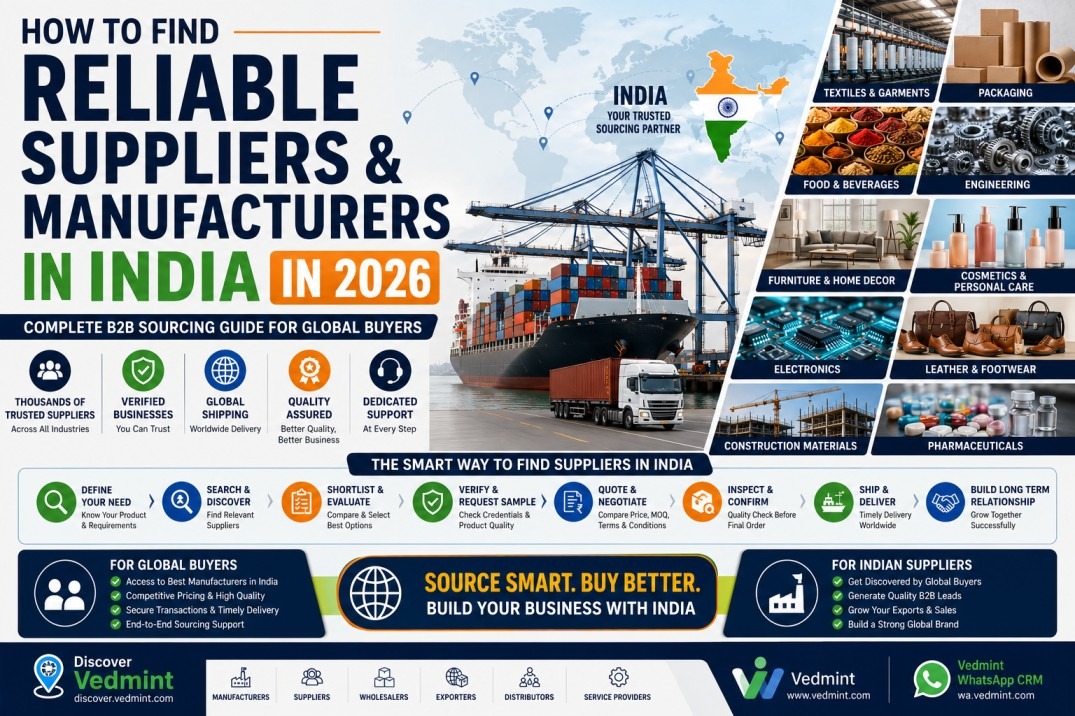
How to Find Reliable Suppliers & Manufacturers in India in 2026: Complete B2B Sourcing Guide for Global Buyers
Whether you are an ecommerce entrepreneur in the United States, a retailer in the United Kingdom, an importer in the UAE, a distributor in Europe, or a business anywhere else in the world, India offers access to an enormous range of products and manufacturing capabilities.
How to Find Reliable Suppliers & Manufacturers in India in 2026: Complete B2B Sourcing Guide for Global Buyers
India has become an important sourcing destination for companies looking for manufacturers, wholesalers, exporters, technology partners, and B2B suppliers.
But finding suppliers is only the beginning.
The real challenge is finding a supplier that can consistently meet your requirements for:
Quality
Price
Production capacity
Minimum order quantity
Lead time
Packaging
Communication
Documentation
Compliance
Shipping
After-sales support
A search for suppliers in India can produce thousands of results.
So how do you identify which suppliers deserve serious consideration?
How do you verify an Indian manufacturer before sending money?
Should you work directly with a factory, wholesaler, exporter, or sourcing company?
How do you request samples?
What should an RFQ contain?
How do you compare quotations?
And how can international buyers discover Indian manufacturers more efficiently?
This comprehensive 2026 B2B sourcing guide answers those questions and more.
Businesses can also explore companies, manufacturers, suppliers, and service providers through Discover Vedmint at discover.vedmint.com.
How to Find Suppliers in India: Quick Answer
If you are looking for reliable suppliers in India, follow this process:
Define the exact product you need.
Create detailed product specifications.
Determine your expected quantity.
Decide whether you need a manufacturer, wholesaler, distributor, or exporter.
Search using product-specific keywords.
Explore relevant business discovery platforms.
Shortlist multiple potential suppliers.
Verify their business information.
Confirm whether they actually manufacture the product.
Request a product catalogue.
Ask about minimum order quantity.
Request samples where appropriate.
Compare quotations.
Verify relevant certifications and product standards.
Assess production capacity.
Understand lead times.
Discuss packaging requirements.
Clarify payment terms.
Understand shipping responsibilities.
Conduct appropriate due diligence before placing a significant order.
For large or recurring orders, consider independent inspections, audits, professional trade advice, and written commercial agreements.
Why Global Businesses Source Products from India
India has a highly diverse supplier ecosystem.
International buyers can source products ranging from traditional handcrafted goods to sophisticated engineering components and technology services.
Important sourcing categories include:
Textiles
Clothing
Home textiles
Furniture
Handicrafts
Jewellery
Leather goods
Footwear
Food products
Spices
Tea
Rice
Packaging
Chemicals
Pharmaceuticals
Cosmetics
Engineering products
Auto components
Machinery
Electrical products
Electronics
Construction materials
Renewable-energy products
Corporate merchandise
Software development
IT services
The right sourcing strategy depends heavily on the product.
Buying 500 customized bags is very different from purchasing industrial machinery.
Your supplier-evaluation process should reflect that difference.
Manufacturer vs Supplier: What Is the Difference?
One of the first mistakes buyers make is assuming every supplier is a manufacturer.
They are not necessarily the same.
Manufacturer
A manufacturer physically produces a product or performs substantial production processes.
Working directly with a manufacturer can offer advantages when you need:
Large quantities
Customization
Private labeling
Product development
Regular production
Better control over specifications
However, manufacturers may have higher MOQs.
What Is a Supplier?
“Supplier” is a broad term for a business providing products to another company.
A supplier could be:
Manufacturer
Wholesaler
Distributor
Exporter
Dealer
Trading company
That is why you should ask:
“Do you manufacture this product yourself?”
Then ask which production processes are performed internally and which are outsourced.
What Is a Wholesaler?
Wholesalers typically purchase products in larger quantities and resell them to businesses.
Wholesalers can be useful when you:
Need lower quantities
Want multiple products
Do not require extensive customization
Need products faster than custom manufacturing allows
What Is an Exporter?
An exporter specializes in selling and shipping products internationally.
Some exporters own manufacturing facilities.
Others source products from multiple manufacturers.
Working with an exporter can simplify sourcing in certain situations, particularly when the exporter understands international documentation and logistics.
What Is a Trading Company?
A trading company acts as an intermediary between buyers and manufacturers or suppliers.
This is not automatically a problem.
A good trading company can provide:
Supplier sourcing
Product consolidation
Quality coordination
Export documentation
Communication
Logistics assistance
The important thing is knowing who you are dealing with.
Step 1: Define Exactly What You Need
Never start supplier outreach with:
“Send me your best products and price.”
That is too broad.
A serious B2B sourcing request should clearly communicate what you want.
For example:
Product: Men's cotton T-shirt
Material: 100% cotton
Fabric weight: Required GSM
Sizes: S–XXL
Quantity: 5,000 pieces
Colors: Black, white, navy
Branding: Private label
Printing: Front and back
Packaging: Individual polybag or specified alternative
Destination: United States
Target delivery: Required date
The more specific your requirement, the more useful supplier quotations become.
Step 2: Create Product Specifications
Your specification sheet can include:
Dimensions
Materials
Weight
Color
Finish
Tolerances
Components
Packaging
Labeling
Performance requirements
Testing requirements
Applicable standards
For technical products, drawings and engineering specifications may also be required.
Do not assume suppliers understand your requirements from a product photo alone.
Step 3: Determine Your Order Quantity
Quantity affects almost everything:
Unit price
MOQ
Manufacturing method
Packaging
Shipping
Supplier interest
Negotiation
Be realistic.
If you need only 50 units, a large factory designed for million-unit production may not be the right supplier.
Likewise, a small workshop may not be suitable if you require hundreds of thousands of units every month.
Step 4: Understand MOQ
MOQ means Minimum Order Quantity.
Suppose a manufacturer says:
MOQ: 1,000 units
That generally means the supplier requires at least 1,000 units under the quoted manufacturing terms.
Why do manufacturers have MOQs?
Production involves setup costs.
Depending on the product, a manufacturer may need to:
Purchase raw materials
Configure machinery
Create printing plates
Develop molds
Prepare tooling
Set up production lines
Produce packaging
Small production runs may therefore be uneconomical.
Can You Negotiate MOQ?
Sometimes.
You might negotiate by:
Paying a higher unit price
Using existing materials
Choosing standard colors
Removing customization
Combining variants
Paying setup costs
But do not pressure a manufacturer into an order size that makes little operational sense.
A supplier reluctantly accepting an uneconomical order is not always a win.
Step 5: Search Using Specific B2B Keywords
Instead of searching:
“suppliers India”
search:
“organic cotton T-shirt manufacturer India”
Instead of:
“packaging supplier India”
search:
“custom corrugated box manufacturer India”
Instead of:
“furniture India”
search:
“solid wood furniture exporter India.”
Specific searches reduce irrelevant results.
Best Keywords for Finding Indian Manufacturers
Useful search patterns include:
[Product] manufacturer India
[Product] supplier India
[Product] wholesale supplier India
[Product] exporter India
[Product] factory India
[Product] OEM manufacturer India
[Product] private label manufacturer India
[Product] manufacturer + city
For example:
“garment manufacturer Tiruppur”
“furniture exporter Jodhpur”
“engineering manufacturer Faridabad”
“textile supplier Surat”
Step 6: Use Business Discovery Platforms
Business discovery platforms can help buyers explore potential companies across multiple categories.
Buyers looking for Indian businesses can explore:
Discover Vedmint — discover.vedmint.com
Search by industry and product category, then independently evaluate relevant companies.
Do not rely on a single discovery source for high-value procurement.
Use multiple sources to create your shortlist.
Step 7: Build a Supplier Shortlist
Do not contact 500 random companies.
Start with perhaps 10–20 potentially relevant suppliers.
Then evaluate:
Product specialization
Manufacturing capability
Location
MOQ
Export experience
Capacity
Certifications
Communication
Customer profile
Reduce that group to a smaller set for serious evaluation.
Step 8: Verify the Supplier's Business Identity
Before making a significant payment, confirm who the supplier actually is.
Depending on the transaction, check appropriate official or authoritative sources for:
Registered business name
Relevant tax registration
Business address
Company registration
Export-related registrations where applicable
Industry licenses
Product-specific approvals
The exact checks depend on the business and product.
Step 9: Verify the Factory
A professional website does not prove that a business owns a factory.
Ask:
Where is your manufacturing facility?
Which processes happen at your facility?
Which processes are outsourced?
How many production lines do you operate?
What is your monthly capacity?
Can you provide recent facility images or video?
Can an inspection be arranged?
For substantial orders, consider an independent factory audit.
Step 10: Evaluate Production Capacity
Suppose your forecast is:
Initial order: 20,000 units
Monthly requirement after launch: 100,000 units
Your supplier must be able to support future demand.
Ask about:
Current monthly capacity
Available capacity
Maximum capacity
Peak-season lead times
Equipment
Workforce
Backup production plans
Do not choose a supplier based only on whether it can produce your first order.
Think about scalability.
Step 11: Request Product Samples
Samples are one of the most important parts of sourcing.
A sample can help you evaluate:
Material
Dimensions
Color
Finish
Functionality
Printing
Branding
Packaging
Overall quality
Some samples may be free.
Others may require payment.
Customized samples may cost significantly more than standard samples.
Golden Sample vs Production Sample
For custom products, you may approve a final reference sample before mass production.
This becomes a benchmark for production quality.
Document your approval carefully.
Do not rely only on verbal descriptions.
Step 12: Request a Professional Quotation
A quotation should ideally identify:
Product
Specification
Quantity
Unit price
MOQ
Tooling/setup charges
Packaging
Taxes where applicable
Production lead time
Payment terms
Shipping terms
Quote validity
For international transactions, make sure both sides understand the applicable trade terms.
Step 13: Compare Total Cost, Not Just Unit Price
Supplier A offers:
$4.00/unit
Supplier B offers:
$4.30/unit
It may seem obvious to choose Supplier A.
But what if Supplier A has:
Higher defect rates
Expensive packaging
Longer lead times
Higher freight costs
Poor communication
Supplier B may produce a lower total landed cost.
Compare the complete commercial picture.
Build a Supplier Scorecard
Use a structured comparison:
Factor | Supplier A | Supplier B | Supplier C |
|---|---|---|---|
Product quality | |||
Unit price | |||
MOQ | |||
Capacity | |||
Lead time | |||
Customization | |||
Certifications | |||
Export experience | |||
Communication | |||
Payment terms | |||
Overall risk |
Weight the factors according to your business priorities.
Step 14: Verify Certifications
Certification requirements depend on:
Product
Industry
Destination country
Buyer requirements
Do not accept a certificate simply because a supplier sends you a PDF.
Check:
Certificate holder
Scope
Issuing organization
Validity
Product coverage
Where important, independently verify it with the relevant issuing or authoritative body.
Step 15: Understand Quality Control
Ask the manufacturer:
How are incoming materials inspected?
What checks occur during production?
How is final inspection performed?
How are defective units handled?
Is batch traceability available?
Are test reports available where relevant?
For large orders, define your quality expectations before production begins.
Step 16: Consider Pre-Shipment Inspection
A pre-shipment inspection happens after goods are substantially produced but before they are shipped.
Depending on the inspection scope, inspectors may check:
Quantity
Appearance
Dimensions
Workmanship
Packaging
Labeling
Basic functionality
Agreed specifications
Technical products may require specialized testing beyond a general inspection.
Step 17: Understand Lead Time
Lead time can include:
Sample development → Approval → Material procurement → Manufacturing → Quality control → Packaging → Dispatch
Ask suppliers to separate:
Sample lead time
Production lead time
Packaging time
Dispatch time
Do not confuse production completion with arrival at your warehouse.
International transportation and customs add additional time.
Step 18: Discuss Packaging Early
Packaging affects:
Product protection
Freight volume
Shipping cost
Branding
Retail presentation
Regulatory compliance
Specify:
Individual packaging
Master cartons
Carton dimensions
Carton weight
Labels
Barcodes
Shipping marks
Pallet requirements
Do this before finalizing pricing.
Step 19: Understand International Shipping
International buyers typically use:
Courier
Useful for:
Samples
Documents
Small shipments
Air Freight
Useful for higher-value or time-sensitive cargo.
Sea Freight
Common for larger commercial shipments.
The right method depends on:
Weight
Volume
Value
Urgency
Destination
Step 20: Understand Incoterms
Incoterms are standardized international trade terms published by the International Chamber of Commerce.
They define important responsibilities between buyers and sellers.
Common examples include:
EXW
FCA
FOB
CIF
DAP
DDP
The appropriate term depends on your transaction and transport method.
Use the current official Incoterms rules and professional trade advice when needed rather than relying on informal internet definitions for significant shipments.
Step 21: Clarify Payment Terms
Payment structures vary by industry, order size, relationship, and risk.
Potential arrangements include:
Advance + balance
Milestone payments
Letter of credit
Documentary arrangements
Other negotiated terms
New buyers and suppliers should both manage risk carefully.
For substantial transactions, appropriate banking, contractual, and trade-finance advice can be valuable.
Never Send Money Without Verification
Fraud can occur in international trade.
Before transferring significant funds:
Verify the company
Verify the recipient
Independently confirm bank details
Review contractual documentation
Confirm invoice details
Investigate unexpected bank-account changes
A last-minute message claiming:
“Our bank account changed—send payment here instead”
should trigger additional verification through an independently established communication channel.
Finding Clothing Manufacturers in India
India has large apparel-manufacturing ecosystems.
Buyers can source:
T-shirts
Shirts
Dresses
Sportswear
Kidswear
Workwear
Uniforms
Private-label fashion
Important manufacturing hubs include regions around:
Tiruppur
Delhi NCR
Bengaluru
Ludhiana
Jaipur
Mumbai
Surat
Your best location depends on the product.
Finding Textile Suppliers in India
India produces:
Cotton
Knits
Woven fabrics
Denim
Silk
Home textiles
Technical textiles
Buyers should specify:
Composition
GSM
Width
Construction
Finish
Color
Testing requirements
Finding Packaging Manufacturers in India
Packaging buyers can source:
Corrugated boxes
Flexible packaging
Paper bags
Labels
Bottles
Pouches
Ecommerce packaging
Retail packaging
Packaging specifications should be based on actual product and shipping requirements.
Finding Furniture Manufacturers in India
Indian furniture manufacturers serve:
Retailers
Hotels
Offices
Interior companies
Importers
Ecommerce brands
Important considerations include:
Material
Construction
Finish
Dimensions
Packaging
Assembly
Shipping volume
International buyers sourcing wooden products should understand applicable timber, treatment, sustainability, and import requirements.
Finding Handicraft Exporters in India
India has long-established handicraft industries.
Products include:
Wooden decor
Metal decor
Handmade textiles
Gifts
Decorative accessories
Artisan products
Regions such as Jaipur, Jodhpur, Moradabad, and other craft clusters can be relevant depending on the product.
Finding Jewellery Manufacturers in India
India has large jewellery manufacturing and trading ecosystems.
Buyers should pay particular attention to:
Material
Purity
Stone specifications
Weight
Certification
Product regulations
Insurance
Secure logistics
Finding Food Suppliers in India
India supplies:
Rice
Spices
Tea
Coffee
Snacks
Processed foods
Agricultural products
Food imports are heavily regulated in many markets.
Verify:
Food-safety requirements
Testing
Labeling
Packaging
Shelf life
Traceability
Destination-country regulations
Finding Spice Exporters in India
India is globally associated with spice production and trade.
Buyers may source:
Turmeric
Cumin
Chilli
Coriander
Pepper
Cardamom
Spice blends
Product testing and contamination controls can be particularly important.
Finding Engineering Manufacturers in India
India has a broad engineering ecosystem producing:
Fasteners
Pumps
Valves
Castings
Forgings
Machined components
Fabricated products
Industrial machinery
Engineering RFQs should contain proper:
Drawings
Dimensions
Tolerances
Material grades
Standards
Testing requirements
Finding Auto Component Manufacturers
India has a major automotive manufacturing ecosystem.
Potential products include:
Components
Electrical systems
Castings
Forgings
Rubber components
Plastic components
Machined parts
Technical validation is essential.
Finding Cosmetic Manufacturers in India
Private-label cosmetic manufacturing can be attractive to international brands.
Products can include:
Skincare
Haircare
Personal care
Beauty products
Regulatory requirements vary by destination.
A product legally manufactured in India is not automatically approved for sale in every other country.
Finding Pharmaceutical Manufacturers
Pharmaceutical sourcing is highly regulated.
Buyers must conduct extensive regulatory, quality, licensing, and supply-chain due diligence.
Work with appropriately qualified professionals and relevant regulatory authorities.
Finding Electronics Manufacturers in India
India's electronics manufacturing ecosystem includes:
Components
Assemblies
PCB manufacturing
Consumer electronics
Electrical products
Industrial electronics
Evaluate:
Technical capabilities
Testing
Component sourcing
Traceability
Certifications
Production capacity
Finding Private Label Manufacturers in India
Private-label manufacturing is popular for:
Cosmetics
Food
Clothing
Home products
Personal care
Accessories
Search using:
[Product] private label manufacturer India
For example:
private label skincare manufacturer India
Finding OEM Manufacturers in India
OEM sourcing is common in:
Engineering
Electronics
Automotive
Machinery
Consumer products
Provide accurate drawings, specifications, testing criteria, and intellectual-property terms where appropriate.
Best Manufacturing Hubs in India
India is not one single manufacturing market.
Different regions specialize in different industries.
Delhi NCR
Relevant industries include:
Garments
Packaging
Electronics
Engineering
Furniture
Printing
Consumer goods
Technology
Noida & Greater Noida
Strong areas include:
Electronics
Technology
Packaging
Consumer products
Manufacturing
Export-oriented businesses
Faridabad
Known for substantial:
Engineering
Fabrication
Machinery
Auto-component
Industrial manufacturing
Gurugram
Gurugram has a strong corporate, automotive, technology, consulting, and business-services ecosystem.
Ghaziabad
Relevant industries include:
Engineering
Steel
Machinery
Packaging
Industrial products
Mumbai & Maharashtra
The broader Maharashtra ecosystem includes:
Pharmaceuticals
Chemicals
Engineering
Food processing
Consumer products
Automotive
Pune
Strong sectors include:
Automotive
Engineering
Machinery
Industrial technology
Ahmedabad
Important sectors include:
Textiles
Pharmaceuticals
Chemicals
Engineering
Packaging
Surat
Particularly important for:
Textiles
Garments
Diamonds
Fashion supply chains
Rajkot
Known for engineering and industrial manufacturing.
Morbi
Globally significant for ceramics and tiles.
Bengaluru
Strong in:
Technology
Electronics
Aerospace
Engineering
Advanced manufacturing
Chennai
Important for:
Automotive
Engineering
Electronics
Industrial manufacturing
Hyderabad
Strong in:
Pharmaceuticals
Technology
Engineering
Manufacturing
Coimbatore
Known for:
Engineering
Pumps
Machinery
Textiles
Industrial products
Tiruppur
A major apparel and knitwear manufacturing hub.
Jaipur
Important for:
Textiles
Jewellery
Handicrafts
Fashion
Furniture
Jodhpur
Known internationally for furniture and handicrafts.
Ludhiana
Strong in:
Hosiery
Garments
Bicycles
Engineering
Kanpur
Relevant sectors include:
Leather
Engineering
Textiles
Industrial products
How USA Buyers Can Find Suppliers in India
American businesses sourcing from India should begin by understanding U.S. import requirements for their product.
Consider:
Tariff classification
Duties
Product safety
Labeling
Customs documentation
Intellectual property
Shipping
Insurance
Product-specific regulations can differ dramatically.
Food, cosmetics, medical products, children's products, electronics, and ordinary furniture, for example, do not have identical requirements.
How Canadian Buyers Can Source from India
Canadian businesses should evaluate applicable:
Customs requirements
Duties and taxes
Product standards
Labeling
Safety requirements
Import documentation
Confirm requirements before production whenever labeling or packaging must be customized.
How UK Buyers Can Find Indian Suppliers
UK importers should understand applicable:
Customs requirements
Product standards
Labeling
VAT considerations
Product-specific regulations
Do not assume EU and UK requirements are identical.
How European Buyers Can Source from India
European buyers should evaluate applicable EU and national requirements.
Depending on the product, areas can include:
Product safety
CE marking where applicable
Chemicals
Materials
Packaging
Sustainability
Labeling
Traceability
Build compliance into the sourcing process before mass production.
How UAE Buyers Can Find Indian Suppliers
India and the UAE have extensive commercial links.
Popular sourcing categories include:
Food
Textiles
Jewellery
Furniture
Building materials
Machinery
Consumer products
UAE buyers should verify relevant customs, conformity, labeling, and product-specific requirements.
Finding Indian Suppliers for Saudi Arabia
Saudi importers should understand the applicable product-registration, conformity, labeling, customs, and other requirements for their category.
Work with qualified import and regulatory professionals where necessary.
Finding Indian Suppliers for the Middle East
Indian businesses supply products across:
UAE
Saudi Arabia
Qatar
Oman
Bahrain
Kuwait
Other regional markets
International buyers should evaluate suppliers individually rather than assuming export capability.
Finding Indian Suppliers for Australia
Australian importers should pay particular attention to applicable:
Biosecurity requirements
Customs
Product safety
Labeling
Material restrictions
Products containing wood, plant materials, food, or other biosecurity-sensitive materials can require additional scrutiny.
Finding Indian Suppliers for New Zealand
New Zealand also maintains strict biosecurity controls.
Verify import requirements before shipping products containing biological or natural materials.
Finding Indian Suppliers for Africa
African markets are diverse.
Requirements in South Africa, Kenya, Nigeria, Ghana, Tanzania, Egypt, and other countries differ.
Do not treat Africa as one regulatory market.
Evaluate:
Import regulations
Product standards
Shipping routes
Payment risks
Distribution
Local support
country by country.
Finding Indian Suppliers for Southeast Asia
Businesses in Singapore, Malaysia, Indonesia, Thailand, Vietnam, the Philippines, and other markets can source a broad range of products from India.
Evaluate regional trade arrangements and local import requirements.
Finding Indian Suppliers for Japan
Japanese buyers often place significant emphasis on:
Quality consistency
Specifications
Documentation
Reliability
Packaging
Communication
Suppliers targeting Japan should be prepared for detailed quality requirements.
Finding Indian Suppliers for Global Ecommerce
Ecommerce brands can source:
Clothing
Home products
Accessories
Beauty products
Packaging
Gifts
Handicrafts
Private-label products
But calculate landed economics carefully.
A low factory price does not automatically mean a profitable ecommerce product.
Calculate Your True Landed Cost
Your actual cost may include:
Product cost + Packaging + Inland transport + Export charges + Freight + Insurance + Customs duties + Taxes + Inspection + Warehousing + Final delivery
For example, a product costing $5.00 at the factory may cost substantially more by the time it reaches your warehouse.
Always model landed cost before placing a major order.
Common Mistakes Global Buyers Make
Mistake 1: Choosing Only on Price
Cheap products can become expensive when defects, delays, and returns occur.
Mistake 2: Skipping Samples
Never assume production quality from photos.
Mistake 3: Unclear Specifications
If your requirements are vague, the supplier may produce something different from what you imagined.
Mistake 4: Not Verifying the Supplier
A website is not sufficient due diligence.
Mistake 5: Ignoring Lead Time
Late inventory can damage sales.
Mistake 6: Ignoring Packaging
Poor packaging can destroy otherwise good products during transportation.
Mistake 7: Assuming Certifications Are Genuine
Verify important documentation independently.
Mistake 8: Paying Without Appropriate Controls
Use sensible payment-risk management.
Mistake 9: Ignoring Import Regulations
A supplier may be able to manufacture a product that cannot legally be imported or sold in your market without additional compliance.
Mistake 10: No Quality-Control Plan
Quality expectations should be defined before mass production.
Red Flags When Evaluating Suppliers
Be cautious if a supplier:
Avoids basic company-verification questions
Provides inconsistent business information
Refuses appropriate inspection
Claims unrealistic production capabilities
Offers prices dramatically below the market without explanation
Pressures you to transfer funds immediately
Suddenly changes bank details
Cannot explain manufacturing processes
Provides unverifiable certifications
Refuses written commercial documentation for substantial orders
One red flag does not automatically prove fraud.
But multiple inconsistencies deserve serious investigation.
How to Write a Professional RFQ
Use a clear message.
Subject: RFQ – 10,000 Custom Cotton T-Shirts for USA
Hello,
We are sourcing a manufacturer in India for custom cotton T-shirts.
Product requirements:
Product: Men's T-shirt
Material: 100% cotton
Quantity: 10,000 pieces
Sizes: S–XXL
Colors: Black, white and navy
Branding: Private label
Printing: Custom
Packaging: Individual packaging
Destination: United States
Please provide:
MOQ
Unit price
Sample cost
Sample lead time
Production lead time
Packaging details
Payment terms
Export experience
Relevant certifications
Shipping terms
This format makes it much easier for qualified suppliers to respond meaningfully.
Should You Visit the Factory?
For strategic suppliers and large contracts, a factory visit can be extremely useful.
A visit can help you understand:
Production process
Equipment
Workforce
Quality systems
Capacity
Warehousing
Management
Overall operations
If you cannot travel to India, consider independent inspection or audit services appropriate to your transaction.
Should You Use Multiple Suppliers?
Depending on your business, relying on one supplier can create concentration risk.
Potential disruptions include:
Equipment failure
Material shortages
Logistics problems
Capacity constraints
Natural disasters
Financial difficulties
For critical products, developing backup suppliers can improve resilience.
Building Long-Term Relationships with Indian Suppliers
B2B sourcing should not always be treated as a one-time price negotiation.
Good supplier relationships can create benefits such as:
Better communication
Product improvements
More predictable production
Better planning
Faster problem resolution
Joint innovation
Treat reliable suppliers as important business partners.
How Discover Vedmint Can Help Buyers Discover Indian Businesses
Finding suppliers across hundreds of categories can be difficult.
Business discovery platforms can make initial research easier.
Global buyers can explore companies and providers through:
Discover Vedmint — discover.vedmint.com
Potential categories include:
Manufacturers
Suppliers
Wholesalers
Exporters
Distributors
Service providers
Technology companies
B2B companies
After finding potential partners, buyers should conduct their own due diligence before entering transactions.
Are You an Indian Manufacturer or Supplier?
International buyers cannot contact your company if they cannot find it.
If you operate a:
Manufacturing company
Factory
Wholesale business
Export company
Distribution business
Trading company
B2B service company
your digital presence should explain exactly what you offer.
What International Buyers Want to See
A strong manufacturer profile should include:
Products
Clearly show what you manufacture or supply.
Specifications
Provide useful technical information.
MOQ
Mention minimum-order expectations where appropriate.
Capacity
Help buyers understand whether you can handle their requirements.
Factory Location
Explain where manufacturing takes place.
Export Markets
Mention countries or regions you genuinely serve.
Certifications
Publish only legitimate, current certifications.
Images
Use authentic product and facility images.
Contact Information
Make it easy for serious buyers to contact your sales or export team.
SEO for Indian Manufacturers
If you manufacture corrugated boxes, do not optimize your website only for your company name.
Potential buyers may search:
corrugated box manufacturer India
corrugated box supplier India
custom packaging manufacturer India
ecommerce box manufacturer
corrugated box exporter India
Create useful pages around actual products and buyer requirements.
SEO for Indian Exporters
Exporters can target:
[Product] exporter India
and relevant international searches such as:
[Product] supplier India for USA
But country-specific pages should contain genuine information.
Do not generate hundreds of identical pages with only the country name changed.
B2B Lead Management for Manufacturers
Suppose enquiries arrive through:
Website
Discover Vedmint
WhatsApp
Email
Trade shows
Social media
Referrals
Without a system, sales teams can lose track of:
Who requested a quotation
Which sample was sent
Who needs follow-up
Which country the buyer is from
Which product they requested
Which opportunity is close to conversion
This is where CRM becomes valuable.
Vedmint CRM for Manufacturers, Suppliers & Exporters
Manufacturers can use CRM to organize:
Buyer enquiries
International leads
Follow-ups
Quotations
Dealers
Distributors
Customer relationships
Sales pipelines
Businesses looking for CRM, ERP, custom software, and technology solutions can explore:
Vedmint — www.vedmint.com
Vedmint WhatsApp CRM for B2B Leads
Many B2B enquiries begin with messages such as:
“Send catalogue.”
“What is your MOQ?”
“Do you export to USA?”
“Need 50,000 units.”
“Send quotation.”
“Can you private label?”
“Can I get a sample?”
These messages may represent serious commercial opportunities.
Businesses can explore:
Vedmint WhatsApp CRM — wa.vedmint.com
to manage WhatsApp-based customer conversations and leads more systematically.
Frequently Asked Questions About Finding Suppliers in India
1. How do I find suppliers in India?
Search by specific product, explore business discovery platforms, industry resources, trade events, referrals, and supplier databases, then independently verify shortlisted companies.
2. How do I find manufacturers in India?
Use searches such as “[product] manufacturer India” and evaluate whether the company actually performs manufacturing.
3. How do I find wholesale suppliers in India?
Search using product + wholesaler, wholesale supplier, bulk supplier, or distributor.
4. How do I find exporters in India?
Search product-specific exporter keywords and verify actual export experience.
5. Is India good for sourcing?
India has extensive manufacturing capabilities across many industries, but suitability depends on your particular product, supplier, economics, and market requirements.
6. What products can I source from India?
Common categories include textiles, clothing, furniture, food, handicrafts, engineering products, chemicals, electronics, packaging, cosmetics, leather products, and many others.
7. How do I verify an Indian supplier?
Check legal identity, business address, relevant registrations, factory capability, certifications, references, and other transaction-specific information.
8. How can I tell whether a supplier is a manufacturer?
Ask for factory details, production capabilities, equipment, capacity, and information about which processes are performed internally.
9. Should I visit the factory?
For large or strategic procurement, a factory visit can provide valuable additional information.
10. What if I cannot visit India?
Consider independent audits, inspections, video meetings, references, and other verification methods.
11. What is MOQ?
MOQ means Minimum Order Quantity.
12. Can MOQ be negotiated?
Sometimes, depending on product, setup costs, materials, and supplier flexibility.
13. Should I request samples?
Yes, where practical and appropriate.
14. Are supplier samples free?
Not always.
15. What is a golden sample?
It is an approved reference sample used as a benchmark for production.
16. What is RFQ?
RFQ means Request for Quotation.
17. What should an RFQ include?
Include product specifications, quantity, customization, packaging, destination, required timeline, and other relevant requirements.
18. How many suppliers should I contact?
There is no fixed number, but comparing several qualified suppliers is generally better than relying on one initial quotation.
19. Should I choose the cheapest supplier?
Not automatically.
20. What is landed cost?
Landed cost is the total cost of getting a product to its destination, including relevant product, shipping, duties, taxes, and related costs.
21. What is lead time?
Lead time is the time required to complete production or supply according to agreed terms.
22. What is production capacity?
It describes how much a manufacturer can produce during a given period.
23. What is private-label manufacturing?
A manufacturer produces products sold under another company's brand.
24. What is OEM manufacturing?
OEM commonly involves manufacturing products or components according to another company's requirements.
25. What is ODM?
ODM generally involves a manufacturer providing product-design and manufacturing capabilities that buyers can market under their own brands.
26. What is a trading company?
A trading company sources or sells products without necessarily manufacturing them itself.
27. Are trading companies bad?
No. Good trading companies can provide valuable sourcing and coordination services.
28. What is a distributor?
A distributor supplies products through specific territories or sales channels.
29. What is an exporter?
An exporter sells and ships goods internationally.
30. Can Indian factories manufacture private-label products?
Many do, depending on industry and MOQ.
31. How do I find clothing manufacturers in India?
Search by clothing type and relevant manufacturing hubs.
32. How do I find textile suppliers?
Specify material, construction, GSM, width, finish, quantity, and testing requirements.
33. How do I find furniture exporters?
Search by material and furniture category plus “exporter India.”
34. How do I find packaging manufacturers?
Search by packaging type, dimensions, material, quantity, and location.
35. How do I find food exporters?
Search by exact food product and verify food-safety and export compliance.
36. How do I find spice suppliers?
Search by spice type, grade, processing, testing, packaging, and export requirements.
37. How do I find engineering suppliers?
Use technical specifications, material grades, drawings, standards, and quantity.
38. How do I find private-label cosmetic manufacturers?
Search by product + “private label cosmetic manufacturer India” and verify regulatory capability.
39. How do I find electronics manufacturers?
Search by product or component and evaluate engineering, testing, capacity, and quality systems.
40. Which Indian city is best for manufacturing?
There is no single best city. Different regions specialize in different industries.
41. Where can I find garment manufacturers?
Tiruppur, Delhi NCR, Bengaluru, Ludhiana, Jaipur, Surat, Mumbai, and other regions have apparel ecosystems.
42. Where can I find textile manufacturers?
Surat, Ahmedabad, Tiruppur, Ludhiana and other textile clusters can be relevant depending on product.
43. Where can I find furniture manufacturers?
Jodhpur, Jaipur, Delhi NCR and other manufacturing regions may be relevant depending on style and material.
44. Where can I find engineering companies?
Faridabad, Pune, Rajkot, Coimbatore, Chennai and other industrial regions have substantial engineering activity.
45. Can U.S. companies buy directly from Indian manufacturers?
Yes, subject to applicable import, regulatory, contractual, and commercial requirements.
46. Can UK companies source from India?
Yes.
47. Can EU businesses import from India?
Yes, subject to relevant EU and national requirements.
48. Can UAE businesses import from India?
Yes, subject to UAE customs and product-specific requirements.
49. Can Australian companies source from India?
Yes, subject to applicable Australian import and biosecurity rules.
50. Can African businesses source from India?
Yes, with requirements varying significantly by country and product.
51. How long does shipping from India take?
It depends on origin, destination, transport method, customs, and logistics conditions.
52. Is sea freight cheaper than air freight?
For larger shipments it is often more economical, but actual pricing varies.
53. Is air freight faster?
Generally, yes.
54. What is EXW?
EXW is an Incoterm defining a particular allocation of seller and buyer responsibilities.
55. What is FOB?
FOB is an Incoterm commonly used for sea or inland-waterway transport.
56. What is CIF?
CIF is an Incoterm involving cost, insurance, and freight responsibilities according to the official rules.
57. What is DDP?
DDP allocates extensive delivery responsibilities to the seller, subject to applicable rules.
58. Who pays customs duty?
That depends on the agreed Incoterm, import arrangement, and applicable law.
59. What documents are needed?
Documentation depends on product, destination, and shipping method.
60. Should I use a freight forwarder?
A qualified freight forwarder can be valuable for international commercial shipments.
61. What is pre-shipment inspection?
It is an inspection performed before goods are shipped.
62. Who performs supplier inspections?
Buyers can use their own teams or qualified independent inspection providers.
63. What should an inspection check?
The scope can include quantity, workmanship, dimensions, packaging, labeling, functionality, and agreed specifications.
64. Can inspection guarantee perfect products?
No. Inspections reduce risk but do not eliminate it.
65. Should I have a contract?
Significant commercial relationships generally benefit from appropriate written agreements.
66. What should a manufacturing agreement cover?
Depending on the transaction, it may address specifications, quality, delivery, payment, intellectual property, confidentiality, warranties, dispute terms, and other responsibilities.
67. How can I protect product designs?
Use appropriate intellectual-property protections, confidentiality arrangements, contractual provisions, and professional legal advice where necessary.
68. Should I send my complete design immediately?
Share sensitive information according to an appropriate staged due-diligence and confidentiality process.
69. How can I reduce sourcing risk?
Verify suppliers, document specifications, approve samples, inspect production, use appropriate payment controls, and understand import requirements.
70. Should I have backup suppliers?
For critical products, alternative suppliers can reduce concentration risk.
71. How do I negotiate with Indian manufacturers?
Negotiate around total commercial terms rather than only unit price.
72. Can I negotiate payment terms?
Sometimes, especially after establishing a relationship.
73. Can I negotiate packaging?
Yes, depending on product and production requirements.
74. Can manufacturers customize products?
Many can, although customization may increase MOQ, lead time, and cost.
75. Can Indian suppliers ship directly to my customers?
Some may offer relevant fulfilment or shipping arrangements, but capabilities vary.
76. Can I source for Amazon or ecommerce from India?
Yes, but ensure products, labeling, packaging, compliance, and marketplace requirements are satisfied.
77. Can I start with a small order?
Some suppliers support smaller trial orders.
78. How do I scale after a successful trial?
Discuss forecast volume, capacity, pricing, lead times, quality controls, and supply planning with the supplier.
79. How can I find B2B companies in India?
Use targeted search, industry resources, business discovery platforms, and professional networks.
80. What is Discover Vedmint?
Discover Vedmint is a platform for discovering businesses and service providers.
81. Can I find Indian suppliers on Discover Vedmint?
Buyers can explore relevant businesses and categories available through Discover Vedmint.
82. Where is Discover Vedmint?
Visit discover.vedmint.com.
83. Can manufacturers list their business on Discover Vedmint?
Manufacturers can explore available business-listing opportunities.
84. Can exporters list?
Export-oriented companies can use business discovery channels to make their capabilities more visible.
85. Can wholesalers list?
Wholesale businesses can also benefit from digital discovery.
86. What should a supplier profile contain?
Products, specifications, MOQ where relevant, capacity, location, markets served, certifications, images, and contact details.
87. How can Indian manufacturers get international leads?
Use SEO, business listings, product pages, trade events, outbound sales, referrals, and partnerships.
88. Should manufacturers invest in SEO?
SEO can be valuable when potential buyers search online for their products.
89. What keywords should manufacturers target?
Target specific product, supplier, manufacturer, exporter, private-label, OEM, wholesale, and location searches.
90. Should manufacturers target international countries?
Yes when they genuinely serve those markets and can provide useful country-specific information.
91. What is B2B CRM?
A B2B CRM helps companies manage business leads, buyers, sales opportunities, and follow-ups.
92. Do manufacturers need CRM?
Businesses managing significant enquiry volumes can benefit from structured CRM systems.
93. Can exporters use CRM?
Yes. International sales often involve long sales cycles and repeated follow-ups.
94. Does Vedmint provide CRM solutions?
Businesses can explore Vedmint's technology solutions through www.vedmint.com.
95. What is WhatsApp CRM?
WhatsApp CRM helps businesses organize customer and sales conversations connected with WhatsApp.
96. Does Vedmint provide WhatsApp CRM?
Explore wa.vedmint.com.
97. Can manufacturers manage international leads through WhatsApp?
Many businesses use WhatsApp for buyer communication, although communication and record-keeping should be managed professionally.
98. What is the best way to find reliable suppliers in India?
Combine targeted discovery, verification, samples, quotation comparison, quality control, appropriate contracts, and ongoing supplier management.
99. Is there a completely risk-free supplier?
No. Procurement always involves some level of commercial and operational risk.
100. What is the most important sourcing rule?
Verify before you trust, specify before you order, and inspect before you scale.
Final Checklist for Sourcing from India
Before placing a significant order, confirm:
Product specifications are documented
Supplier identity has been checked
Manufacturing capability has been evaluated
Samples have been reviewed where appropriate
MOQ is understood
Pricing is clear
Production capacity is sufficient
Lead time is documented
Packaging requirements are agreed
Quality expectations are documented
Certifications have been verified where relevant
Inspection requirements are established
Payment terms are understood
Bank information has been independently verified
Shipping terms are clear
Import requirements have been checked
Important agreements are documented
Backup plans have been considered
Conclusion: Finding Reliable Suppliers in India
Finding a supplier in India is relatively easy.
Finding the right supplier requires more work.
Successful sourcing comes from a repeatable process:
Define → Search → Discover → Shortlist → Verify → Sample → Compare → Negotiate → Inspect → Ship → Review → Scale
Do not build a supply chain around the cheapest quotation.
Build it around the best combination of:
Quality
Cost
Reliability
Capacity
Communication
Compliance
Delivery
Long-term fit
For buyers looking to discover Indian businesses, manufacturers, suppliers, wholesalers, exporters, and service providers, explore:
Discover Vedmint — discover.vedmint.com
For Indian manufacturers and B2B companies, being discoverable is only the beginning. Every serious enquiry needs to be organized and followed up professionally.
For CRM, ERP, custom software, and business technology solutions:
Vedmint — www.vedmint.com
For managing WhatsApp-based B2B enquiries:
Vedmint WhatsApp CRM — wa.vedmint.com
India offers enormous opportunities for global sourcing.
The companies that get the best results are not simply those that find the lowest price.
They are the ones that build reliable, transparent, scalable supplier relationships that can grow with their business.
Extra pointers for Indian readers
The guide above stays the main reference. The table and questions below help you act on it – compare providers, confirm fees, and search locally when you are ready.
At a glance
| Step | When | Your action |
|---|---|---|
| Define needs | Day 1 | Write must-haves, budget, location |
| Shortlist 3 providers | Day 1–2 | Search by city; save numbers |
| Compare quotes | Day 2–3 | Same questions to each provider |
| Verify details | Before paying | Call to confirm slot and scope |
| Book & confirm | Once satisfied | Written confirmation on chat/email |
| After service | Same week | Note what worked for next time |
Figures and timelines vary by city and provider — use this table for planning, not as a price guarantee.
Save this page if you are mid-search – you can rerun the same checks for the next service you hire.
Common questions people ask
Is How to Find Reliable Suppliers & Manufacturers in India in 2026: Complete B2B So different in metro cities and smaller towns?
Usually yes. Availability, pricing, and travel charges shift between metros and tier-2 cities. Filter by your city or locality, then confirm service area on a quick phone call before you pay.
How do I know if a listing for whether you are an ecommerce entrepreneur in the united states, a retailer in th is still active?
Treat online hours as a hint. Call or WhatsApp the number on the listing, ask if they take new bookings this week, and note who you spoke with. That single step prevents many wasted trips.
What should I prepare before contacting providers about whether you are an ecommerce entrepreneur in the united states, a retailer in th?
Have your location landmark, preferred date or time window, budget range, and any must-haves written down. Providers answer faster when your brief is specific instead of "how much?" alone.
How local is "near me" in practice?
Search tools use city and locality pins, but providers may still charge travel outside a radius. Confirm they serve your pincode or landmark before scheduling.
Is the cheapest quote always the best deal?
Rarely. Lower quotes may exclude tax, travel, materials, or cleanup. Compare line items and ask what happens if the job runs long or needs a return visit.
Do prices for whether you are an ecommerce entrepreneur in the united states, a retailer in th include GST?
Not always on the first quote. Ask whether GST is extra, whether you need a formal invoice, and what name will appear on the bill – especially for business reimbursements.
Does it matter which city I search from (e.g. Delhi NCR)?
Yes. Start with your actual city or locality filter. A great provider in another city is irrelevant if they will not travel to you without heavy surcharges.
Can I pay in cash or UPI – what is safer?
UPI with a note in WhatsApp is common and leaves a trail. For large event or renovation payments, staged transfers tied to milestones reduce risk for both sides.
How do I report outdated information on a listing?
Use contact options on VedList Discover or reach support if something looks wrong. Owners can also claim listings to correct phone numbers and hours directly.
Should I call or WhatsApp first?
WhatsApp lets you share location pins and photos; calls resolve urgent timing faster. Try the channel the listing promotes, then switch if nobody responds within a reasonable window.
Related posts
From the author
Deepak sahu’s latest listings
Explore businesses and institutes from this blog writer.
