
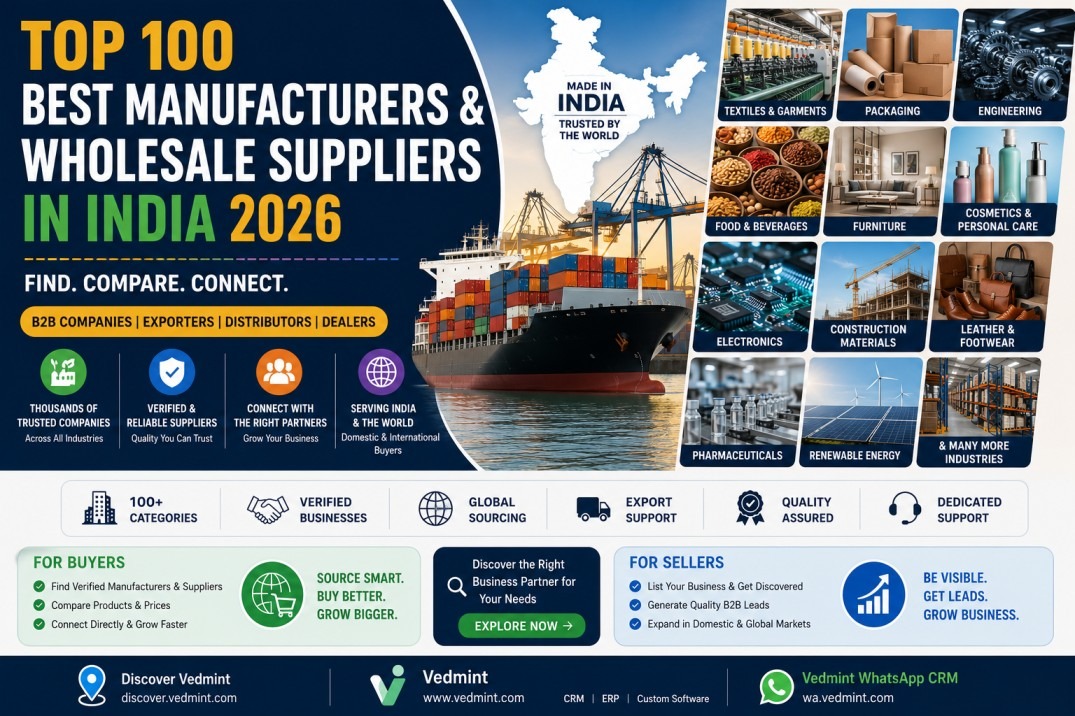
Top 100 Best Manufacturers & Wholesale Suppliers in India 2026: Find B2B Companies, Exporters, Distributors & Dealers
From textiles and garments to engineering components, food products, packaging, furniture, chemicals, electronics, machinery, handicrafts, software, and industrial supplies, businesses around the world source an enormous variety of products and services from Indian companies.
Top 100 Best Manufacturers & Wholesale Suppliers in India 2026: Find B2B Companies, Exporters, Distributors & Dealers
India is one of the world's largest and most diverse sourcing markets.
From textiles and garments to engineering components, food products, packaging, furniture, chemicals, electronics, machinery, handicrafts, software, and industrial supplies, businesses around the world source an enormous variety of products and services from Indian companies.
But there is one major challenge:
How do you find the right manufacturer or supplier in India?
A search for manufacturers in India can return thousands of companies.
The same happens when you search for:
suppliers in India
wholesale suppliers in India
manufacturers near me
exporters in India
B2B companies in India
distributors in India
Indian manufacturers
Indian exporters
wholesale dealers near me
factories in India
The problem is rarely finding a supplier.
The challenge is identifying suppliers that actually match your product, quantity, quality, location, pricing, delivery, compliance, and business requirements.
This comprehensive 2026 guide covers 100 manufacturing and wholesale supplier categories in India and explains how Indian and international buyers can research, compare, verify, and contact potential B2B partners.
Businesses can also explore companies and service providers through Discover Vedmint at discover.vedmint.com.
If you are a manufacturer, wholesaler, exporter, distributor, dealer, or B2B service provider, establishing a strong digital presence can also make it easier for potential buyers to discover your business.
Quick Guide: Finding Manufacturers in India
If you are sourcing from India, use this process:
Define your exact product requirement.
Determine required specifications.
Estimate your order quantity.
Search for specialized manufacturers.
Shortlist multiple suppliers.
Verify their business information.
Request product catalogues.
Ask about MOQ.
Request samples where appropriate.
Compare quotations.
Evaluate manufacturing capacity.
Check lead times.
Verify relevant certifications.
Discuss packaging.
Understand payment terms.
Confirm shipping responsibilities.
Perform appropriate due diligence.
Use written commercial agreements for significant transactions.
International buyers should additionally understand relevant import regulations, customs requirements, taxes, product standards, and documentation in both India and the destination market.
Why Source Products from India?
India has a broad manufacturing ecosystem spanning traditional crafts and modern industrial production.
Depending on the sector, buyers can find suppliers ranging from small specialized workshops to large manufacturing companies.
Important Indian manufacturing industries include:
Textiles
Garments
Pharmaceuticals
Automotive
Engineering
Chemicals
Food processing
Electronics
Machinery
Furniture
Leather
Jewellery
Packaging
Handicrafts
Construction materials
Renewable energy
Consumer goods
This diversity gives domestic and international buyers a large sourcing base.
Manufacturer vs Supplier vs Wholesaler vs Distributor
Before searching, understand what type of business you actually need.
Manufacturer
A manufacturer makes the product.
Working directly with a manufacturer can be useful for:
Large orders
Custom products
Private labeling
Product modifications
Regular procurement
Supplier
“Supplier” is a broader term.
A supplier may be:
A manufacturer
Wholesaler
Distributor
Dealer
Trading company
Wholesaler
A wholesaler generally purchases products in volume and resells them to:
Retailers
Ecommerce sellers
Other wholesalers
Businesses
Wholesalers can be particularly useful for smaller orders across multiple products.
Distributor
A distributor often represents or distributes products from manufacturers within a particular territory or market.
Exporter
An exporter sells and ships products from India to buyers in other countries.
Some manufacturers export directly.
Others work through export companies.
Top 100 Manufacturers & Wholesale Suppliers in India
Textile & Apparel Industry
1. Textile Manufacturers in India
India has a huge textile manufacturing ecosystem.
Buyers can source:
Cotton fabrics
Polyester fabrics
Blended fabrics
Knitted fabrics
Woven fabrics
Printed fabrics
Technical textiles
When evaluating textile suppliers, ask about:
Fabric composition
GSM
Width
Color
Dyeing
MOQ
Production capacity
Testing requirements
2. Garment Manufacturers in India
Garment manufacturers serve:
Fashion brands
Retail chains
Ecommerce businesses
Exporters
Corporate buyers
Products can include:
T-shirts
Shirts
Trousers
Dresses
Jackets
Sportswear
Kidswear
International buyers should request samples before substantial production runs.
3. T-Shirt Manufacturers in India
T-shirts are popular for:
Fashion brands
Corporate merchandise
Events
Promotional campaigns
Ecommerce
Buyers can request different fabrics, GSM, printing, embroidery, labels, and packaging.
4. Uniform Manufacturers in India
Uniform manufacturers serve:
Schools
Hospitals
Hotels
Factories
Restaurants
Security companies
Corporate organizations
5. Sportswear Manufacturers in India
Sportswear suppliers may manufacture:
Jerseys
Tracksuits
Gym wear
Activewear
Sports uniforms
6. Kidswear Manufacturers in India
Children's clothing requires particular attention to material quality and applicable product-safety requirements.
7. Saree Manufacturers & Wholesalers
India has extensive manufacturing and wholesale markets for:
Silk sarees
Cotton sarees
Designer sarees
Printed sarees
Traditional sarees
8. Kurti Manufacturers & Wholesalers
Kurti manufacturers supply retailers, boutiques, ecommerce businesses, and exporters.
9. Denim Manufacturers in India
Denim suppliers can serve fashion brands and garment manufacturers requiring fabric or finished products.
10. Home Textile Manufacturers
Products include:
Bedsheets
Towels
Curtains
Cushion covers
Blankets
Table linen
These products can be attractive to international importers, hospitality companies, and retailers.
Packaging Industry
11. Packaging Manufacturers in India
Packaging is required by almost every product industry.
Indian packaging companies serve:
Food
Ecommerce
Cosmetics
Pharmaceuticals
Electronics
Retail
Manufacturing
12. Corrugated Box Manufacturers
Corrugated boxes are widely used for shipping and product packaging.
Buyers should specify:
Dimensions
Board grade
Ply
Printing
Quantity
Load requirements
13. Paper Bag Manufacturers
Paper bags are used across retail, food, gifting, and other industries.
14. Flexible Packaging Manufacturers
Flexible packaging can include:
Pouches
Laminates
Printed films
Sachets
Product packaging
15. Food Packaging Suppliers
Food businesses require packaging appropriate for the product and applicable food-contact requirements.
16. Ecommerce Packaging Manufacturers
Ecommerce businesses may need:
Shipping boxes
Mailers
Tape
Labels
Protective packaging
Customized branded packaging
17. Label Manufacturers
Labels are needed across:
Food
Cosmetics
Retail
Pharmaceuticals
Logistics
Manufacturing
18. Bottle Manufacturers
Bottle suppliers can serve beverage, cosmetic, pharmaceutical, household, and industrial markets.
19. Packaging Tape Manufacturers
Packaging tapes are widely used in logistics, ecommerce, manufacturing, and warehousing.
20. Custom Packaging Manufacturers
Brands increasingly seek packaging customized around their:
Product
Dimensions
Branding
Customer experience
Shipping requirements
Food & Beverage Manufacturing
21. Food Product Manufacturers in India
India has an enormous food-processing sector.
Products include:
Snacks
Spices
Packaged foods
Ready-to-eat products
Sauces
Beverages
22. Spice Manufacturers & Exporters
Indian spices are sold globally.
Products can include:
Turmeric
Chilli
Cumin
Coriander
Pepper
Cardamom
Spice blends
International buyers should pay close attention to quality, testing, traceability, and destination-market requirements.
23. Rice Suppliers & Exporters
India is a major global rice supplier.
Buyers may source:
Basmati rice
Non-basmati rice
Specialty rice varieties
Discuss:
Grade
Grain length
Broken percentage
Packaging
Quantity
Shipping terms
24. Tea Manufacturers & Exporters
Indian tea suppliers can offer products from different regions and processing styles.
25. Coffee Suppliers & Exporters
Coffee suppliers can serve roasters, retailers, hospitality businesses, and importers.
26. Snack Manufacturers
Snack manufacturers can supply branded, private-label, and wholesale products.
27. Biscuit Manufacturers
Biscuits and bakery products can be manufactured for domestic distribution or export depending on product and compliance requirements.
28. Dry Fruit Wholesalers
Dry-fruit wholesalers serve:
Retailers
Hotels
Restaurants
Gift companies
Ecommerce businesses
29. Frozen Food Manufacturers
Cold-chain capability is especially important when sourcing frozen products.
30. Private Label Food Manufacturers
Private-label manufacturers can produce goods sold under another company's brand.
This model can be useful for retailers and ecommerce brands.
Furniture & Home Products
31. Furniture Manufacturers in India
Furniture manufacturers can supply:
Residential furniture
Office furniture
Hotel furniture
Restaurant furniture
Institutional furniture
32. Office Furniture Manufacturers
Products may include:
Office chairs
Workstations
Desks
Conference tables
Storage
33. Wooden Furniture Manufacturers
International buyers should ensure wood products meet applicable legal, sustainability, treatment, and destination-market requirements.
34. Hotel Furniture Manufacturers
Hospitality furniture may require customization based on project specifications.
35. School Furniture Manufacturers
Schools and institutions often need bulk furniture such as desks, benches, chairs, and storage.
36. Home Decor Manufacturers
Products can include:
Decorative accessories
Wall decor
Lamps
Decorative textiles
Table accessories
37. Handicraft Manufacturers & Exporters
India has globally recognized handicraft industries.
Products can include:
Wooden crafts
Metal crafts
Textile crafts
Decorative products
Handmade gifts
38. Carpet Manufacturers
Indian carpet manufacturers serve domestic and international buyers across handmade and machine-produced categories.
39. Mattress Manufacturers
Mattress companies can supply retailers, hotels, hospitals, and institutional buyers.
40. Modular Furniture Manufacturers
Modular furniture is increasingly used in homes, offices, kitchens, and commercial spaces.
Engineering & Industrial Products
41. Industrial Machinery Manufacturers
India produces machinery for many industries.
Before purchasing machinery, evaluate:
Capacity
Specifications
Installation
Spare parts
Training
Warranty
After-sales support
42. Machine Tool Manufacturers
Machine tools are used across manufacturing and engineering environments.
43. Industrial Pump Manufacturers
Pumps are required across water, agriculture, construction, chemical processing, and other industries.
44. Valve Manufacturers
Industrial valves are used in multiple fluid-control applications.
Product specifications and relevant standards matter significantly.
45. Bearing Manufacturers & Suppliers
Bearings are widely used in machinery, automotive, and industrial applications.
46. Fastener Manufacturers
Fasteners include:
Bolts
Nuts
Screws
Washers
Industrial fasteners
47. Steel Fabrication Companies
Fabricators can produce structural and custom metal products according to technical requirements.
48. Industrial Equipment Suppliers
Equipment suppliers can provide machinery, tools, components, and production systems.
49. Conveyor Manufacturers
Conveyor systems are used in factories, warehouses, logistics facilities, and processing plants.
50. Material Handling Equipment Manufacturers
Products can include:
Trolleys
Racks
Conveyors
Lifting systems
Warehouse equipment
Construction & Building Materials
51. Cement Suppliers
Construction businesses require reliable supply and appropriate product specifications.
52. Steel Suppliers
Steel suppliers serve:
Construction
Manufacturing
Fabrication
Infrastructure
Engineering
53. TMT Bar Suppliers
TMT bars are widely used in reinforced concrete construction.
Buyers should source products that meet relevant standards and project specifications.
54. Tile Manufacturers
India produces:
Ceramic tiles
Vitrified tiles
Wall tiles
Floor tiles
Decorative tiles
55. Marble Suppliers & Exporters
Indian natural stone is sold domestically and internationally.
56. Granite Manufacturers & Exporters
Granite exporters can supply slabs, tiles, and finished products.
57. Plywood Manufacturers
Plywood is used in furniture, interiors, construction, and commercial applications.
58. Sanitaryware Manufacturers
Products include:
Toilets
Washbasins
Bathroom fixtures
Related sanitary products
59. Hardware Manufacturers
Hardware suppliers serve construction, furniture, industrial, and home-improvement markets.
60. Electrical Product Manufacturers
Products can include:
Switches
Wires
Cables
Lighting
Electrical accessories
Electronics & Technology Products
61. Electronics Manufacturers in India
India's electronics manufacturing ecosystem continues to develop across consumer and industrial applications.
62. LED Light Manufacturers
LED manufacturers can supply:
Bulbs
Panels
Street lights
Commercial lighting
Industrial lighting
63. Cable & Wire Manufacturers
Electrical and communication cable buyers should verify applicable technical specifications and certifications.
64. Electronic Component Suppliers
Component suppliers serve manufacturers, repair companies, technology businesses, and product developers.
65. PCB Manufacturers
Printed circuit board manufacturers can provide prototypes and production runs according to design requirements.
66. Battery Manufacturers
Battery products vary significantly by chemistry and application.
Transportation and safety requirements can also be important, especially for international shipping.
67. Solar Product Manufacturers
Solar manufacturers and suppliers can provide:
Panels
Inverters
Mounting systems
Related equipment
68. Computer Hardware Suppliers
Wholesale suppliers can serve:
IT companies
Offices
Schools
Retailers
System integrators
Beauty, Personal Care & Cosmetics
69. Cosmetic Manufacturers in India
Cosmetic manufacturers can produce:
Skincare
Haircare
Personal care
Beauty products
Businesses should verify all applicable regulatory requirements before manufacturing or importing cosmetics.
70. Private Label Cosmetic Manufacturers
Private-label production allows brands to sell products manufactured by third parties under their own branding.
71. Soap Manufacturers
Soap manufacturers may serve consumer brands, hospitality companies, retailers, and exporters.
72. Shampoo Manufacturers
Brands can source finished or private-label haircare products.
73. Perfume Manufacturers
Fragrance companies may provide finished products or private-label manufacturing.
74. Essential Oil Suppliers
Essential oils can serve cosmetics, fragrance, wellness, and other legitimate commercial industries.
Quality documentation and intended-use requirements should be evaluated carefully.
Leather, Footwear & Accessories
75. Leather Product Manufacturers
Products may include:
Bags
Belts
Wallets
Accessories
Industrial leather goods
International buyers should understand applicable material and destination-market requirements.
76. Footwear Manufacturers
Indian manufacturers produce:
Casual shoes
Formal shoes
Sandals
Slippers
Sports footwear
77. Bag Manufacturers
Bag manufacturers may produce:
Backpacks
Handbags
Laptop bags
Travel bags
Promotional bags
78. Wallet Manufacturers
Wallet manufacturers can serve fashion brands, retailers, corporate gifting companies, and exporters.
Corporate & Promotional Products
79. Corporate Gift Manufacturers & Suppliers
Products can include:
Customized merchandise
Gift sets
Bags
Bottles
Office accessories
80. Promotional Product Suppliers
Promotional merchandise is used for events, marketing campaigns, employees, and customer gifting.
81. Trophy Manufacturers
Trophy suppliers serve schools, sports organizations, companies, events, and institutions.
82. ID Card Manufacturers & Printers
Companies and educational institutions require identification cards and related products.
Medical & Healthcare Supplies
83. Medical Equipment Manufacturers
Healthcare buyers should verify relevant regulatory approvals, standards, certifications, and supplier credentials before purchasing medical equipment.
84. Hospital Furniture Manufacturers
Products can include beds, tables, trolleys, seating, and other institutional furniture.
85. Laboratory Equipment Manufacturers
Laboratories require equipment that meets appropriate technical and safety standards.
Agriculture & Farming
86. Agricultural Equipment Manufacturers
Products can include machinery, implements, irrigation equipment, and other farming tools.
87. Irrigation Equipment Manufacturers
Irrigation suppliers can serve farms, landscaping, commercial agriculture, and infrastructure projects.
88. Agricultural Product Exporters
India exports a wide range of agricultural commodities.
International trade requires appropriate documentation and compliance with destination-market regulations.
Paper, Printing & Stationery
89. Paper Manufacturers & Suppliers
Paper suppliers serve packaging, printing, publishing, offices, and industrial buyers.
90. Stationery Manufacturers
Products can include:
Notebooks
Files
Office supplies
School stationery
91. Notebook Manufacturers
Notebook suppliers can serve schools, companies, distributors, retailers, and promotional buyers.
92. Printing Companies
Commercial printing can include:
Catalogues
Brochures
Packaging
Labels
Books
Promotional material
Logistics & Export Support
93. Freight Forwarders in India
International buyers and exporters often work with freight forwarders to coordinate cargo movement.
94. Logistics Companies in India
Logistics providers can support:
Road freight
Warehousing
Distribution
International shipping coordination
95. Customs Brokers & Clearance Services
International shipments can involve complex customs procedures.
Use appropriately licensed and experienced professionals.
B2B & Business Technology
96. Software Development Companies in India
India is also a major global technology-services market.
Businesses can source:
Custom software
CRM
ERP
SaaS
Web applications
Mobile apps
AI solutions
Businesses looking for technology solutions can explore Vedmint at www.vedmint.com.
97. CRM Solution Providers
Manufacturers, distributors, exporters, and wholesalers can use CRM systems to manage:
Buyer enquiries
Sales leads
Dealers
Distributors
Follow-ups
Customer relationships
98. ERP Solution Providers
ERP systems can help manufacturers manage:
Inventory
Purchases
Production
Sales
Finance
Operations
99. WhatsApp CRM Providers
Indian businesses frequently communicate with buyers through WhatsApp.
Vedmint WhatsApp CRM can help businesses organize WhatsApp-based leads and conversations.
Explore:
100. B2B Companies & Export Partners in India
Sometimes buyers are not searching for one particular product.
They are looking for a long-term partner.
Potential partnerships include:
Manufacturing
Distribution
Technology
Logistics
Outsourcing
Marketing
Supply
Export
Import
Private labeling
Business discovery platforms can help make these connections easier.
How International Buyers Can Find Indian Manufacturers
If you are sourcing from outside India, avoid beginning with thousands of random suppliers.
Start with a clear sourcing brief.
For example:
Product: Cotton T-shirts
Quantity: 10,000 units
Fabric: 100% cotton
GSM: Required specification
Sizes: Required size range
Branding: Private label
Printing: Required design/process
Packaging: Individual packaging
Destination: Buyer's country
Required delivery: Target date
A detailed requirement allows suppliers to respond more accurately.
How to Verify a Manufacturer in India
Verification is especially important for international sourcing.
Depending on the transaction, consider checking:
1. Legal Business Identity
Verify the company's registered identity using appropriate official records.
2. Tax Information
Where relevant, confirm applicable tax-registration information through official channels.
3. Business Address
Understand whether the location is a factory, office, warehouse, or trading address.
4. Manufacturing Capability
Ask:
What equipment do you use?
What is your monthly capacity?
Which products do you manufacture internally?
Which processes are outsourced?
5. Certifications
Request certificates relevant to your product and independently verify important claims.
6. References
For substantial transactions, references from existing buyers can provide additional information.
7. Factory Audit
For high-value or recurring procurement, consider an independent factory audit or inspection where appropriate.
Request Samples Before Large Orders
A sample can help evaluate:
Material
Dimensions
Color
Finish
Packaging
Workmanship
Functionality
But remember:
A perfect sample does not guarantee that every production unit will be identical.
That is why quality-control processes also matter.
What Is MOQ?
MOQ means Minimum Order Quantity.
A manufacturer might say:
MOQ: 1,000 pieces.
This means the manufacturer generally expects an order of at least 1,000 units under the quoted terms.
MOQ can depend on:
Material
Tooling
Customization
Printing
Production process
Packaging
Ask About Production Capacity
Suppose you need 100,000 units every month.
A manufacturer capable of producing only 20,000 units may not be suitable even if its pricing is attractive.
Ask about:
Current capacity
Available capacity
Peak-season capacity
Lead times
Compare More Than Price
Imagine three manufacturers:
Factor | Supplier A | Supplier B | Supplier C |
|---|---|---|---|
Price | Low | Medium | High |
Quality | Medium | High | High |
MOQ | Low | Medium | High |
Lead Time | Long | Medium | Short |
Capacity | Medium | High | High |
Communication | Average | Excellent | Good |
Customization | Limited | Excellent | Good |
Which supplier is best?
There is no universal answer.
It depends on your priorities.
Understanding Supplier Quotations
A quotation should clearly explain important commercial details such as:
Product
Specification
Quantity
Unit price
Taxes where applicable
Packaging
Lead time
Payment terms
Shipping responsibilities
Quote validity
For international orders, also clarify the applicable Incoterm.
Common Incoterms International Buyers Should Know
International trade commonly uses standardized Incoterms published by the International Chamber of Commerce.
Common terms include:
EXW
The buyer assumes substantial responsibility from the seller's premises.
FOB
Frequently used for sea freight, with responsibilities divided according to the agreed FOB terms.
CIF
Generally includes cost, insurance, and freight to the named destination port under the relevant Incoterm rules.
DDP
The seller assumes extensive responsibility for delivering goods to the agreed destination, subject to the applicable terms and local import rules.
Do not choose an Incoterm based only on a short online definition.
For significant international shipments, understand the current official rules and obtain professional logistics or trade advice.
Payment Terms When Buying from India
Payment structures vary.
Examples can include:
Advance payment
Deposit + balance
Letter of credit
Milestone payments
Other negotiated commercial terms
For new supplier relationships, use appropriate risk controls.
Avoid sending substantial funds based solely on messages or unverifiable documents.
Quality Control Before Shipment
For significant orders, buyers may arrange inspections before shipment.
Inspection can check:
Quantity
Dimensions
Appearance
Packaging
Workmanship
Agreed specifications
Specialized products may require laboratory or technical testing.
Shipping Products from India
International shipments can travel by:
Air Freight
Useful when speed matters or shipment size is relatively small.
Sea Freight
Often used for large commercial shipments.
Courier
Can be practical for samples and smaller shipments.
Road/Rail
Important for domestic Indian supply chains and some cross-border routes.
Documents Used in International Trade
Documentation varies by product and destination.
Common documents may include:
Commercial invoice
Packing list
Bill of lading or airway bill
Certificate of origin
Insurance documents
Export documentation
Product-specific certificates
Work with qualified trade and logistics professionals to determine exactly what your shipment requires.
Best Manufacturing Hubs in India
Different regions specialize in different industries.
Delhi NCR
Delhi NCR—including Delhi, Noida, Gurugram, Faridabad, Ghaziabad, and surrounding industrial areas—has a broad ecosystem spanning:
Garments
Packaging
Engineering
Electronics
Furniture
Printing
IT
Corporate products
Manufacturers in Noida
Noida and Greater Noida have strong ecosystems around:
Electronics
IT
Consumer products
Packaging
Manufacturing
Export businesses
Manufacturers in Faridabad
Faridabad has long been associated with:
Engineering
Machinery
Auto components
Fabrication
Industrial products
Manufacturers in Ghaziabad
Ghaziabad has suppliers across:
Steel
Engineering
Machinery
Packaging
Industrial products
Manufacturers in Mumbai
Mumbai and the surrounding Maharashtra industrial ecosystem provide access to:
Chemicals
Pharmaceuticals
Engineering
Food
Consumer goods
Export businesses
Manufacturers in Pune
Pune has strong manufacturing activity around:
Automotive
Engineering
Machinery
Technology
Industrial products
Manufacturers in Ahmedabad
Ahmedabad and Gujarat have major ecosystems in:
Textiles
Chemicals
Pharmaceuticals
Engineering
Packaging
Manufacturers in Surat
Surat is particularly well known for:
Textiles
Garments
Diamonds
Fashion-related wholesale markets
Manufacturers in Rajkot
Rajkot has substantial engineering and industrial manufacturing activity.
Manufacturers in Morbi
Morbi is strongly associated with ceramics and tiles.
Manufacturers in Bengaluru
Bengaluru combines technology with electronics, aerospace, engineering, and modern manufacturing.
Manufacturers in Chennai
Chennai has strong automotive, engineering, electronics, and industrial manufacturing ecosystems.
Manufacturers in Hyderabad
Hyderabad has substantial pharmaceutical, technology, engineering, and manufacturing activity.
Manufacturers in Coimbatore
Coimbatore is associated with engineering, machinery, pumps, textiles, and industrial manufacturing.
Manufacturers in Tiruppur
Tiruppur is one of India's major knitwear and garment manufacturing hubs.
International apparel buyers frequently source from the region.
Manufacturers in Jaipur
Jaipur is known for industries including:
Handicrafts
Textiles
Jewellery
Furniture
Fashion
Manufacturers in Jodhpur
Jodhpur has a significant furniture and handicraft export ecosystem.
Manufacturers in Ludhiana
Ludhiana is strongly associated with:
Hosiery
Garments
Bicycles
Engineering
Industrial products
Manufacturers in Kanpur
Kanpur has manufacturing activity across leather, engineering, textiles, and industrial products.
Manufacturers in Kolkata
Kolkata and eastern India offer manufacturing and trading ecosystems across engineering, leather, textiles, food, and other industries.
International Buyers: Why Consider Indian Suppliers?
International buyers may consider India because of its:
Broad supplier ecosystem
Diverse manufacturing capabilities
Large skilled workforce
English-language business communication
Product customization capabilities
Established export industries
Range of manufacturing clusters
However, sourcing decisions should always be based on actual supplier capabilities rather than assumptions about a country or region.
Finding Indian Manufacturers for USA Buyers
U.S. businesses sourcing from India should evaluate:
Product quality
U.S. import requirements
Tariffs and duties
Product-specific regulations
Shipping
Insurance
Lead times
Supplier reliability
For regulated products, verify applicable U.S. requirements before ordering.
Finding Indian Manufacturers for European Buyers
European buyers should evaluate applicable EU or national requirements relating to areas such as:
Product safety
Materials
Labeling
Sustainability
Packaging
Chemicals
Documentation
Requirements vary substantially by product.
Finding Indian Suppliers for UAE & Middle East Buyers
India has substantial trade relationships across the Middle East.
Buyers can source:
Food
Textiles
Building materials
Engineering products
Furniture
Consumer goods
Technology services
Check destination-specific import and conformity requirements.
Finding Indian Suppliers for Africa
Indian manufacturers export a broad range of products to African markets.
Buyers should carefully evaluate logistics, payment arrangements, regulatory requirements, and after-sales support.
Finding Indian Suppliers for Australia
Australian importers should check relevant biosecurity, customs, product-safety, labeling, and other regulatory requirements depending on the product.
How Discover Vedmint Can Help Businesses Get Discovered
A manufacturer may produce excellent products.
But if buyers cannot discover the company online, opportunities can be lost.
Discover Vedmint gives businesses another place to establish their digital presence.
Explore:
Potential business categories include:
Manufacturers
Suppliers
Wholesalers
Distributors
Exporters
Dealers
Agencies
Service companies
B2B businesses
Manufacturers: Build a Better Business Profile
A useful manufacturer profile should clearly explain:
Company Overview
What does your company manufacture?
Product Categories
List your major products.
Manufacturing Location
Where are your facilities located?
Production Capacity
Give useful capacity information where appropriate.
MOQ
Help buyers understand minimum-order expectations.
Markets Served
Do you serve:
Local buyers?
Pan-India buyers?
International buyers?
Export Capability
If you export, explain your actual export capabilities.
Certifications
List only legitimate, current certifications relevant to your business.
Contact Details
Make it easy for buyers to reach the appropriate team.
Turn B2B Enquiries into Sales
Getting enquiries is only half the challenge.
Suppose your company receives leads from:
Website
Discover Vedmint
WhatsApp
Email
Social media
Trade shows
Referrals
If all those enquiries remain scattered across different inboxes, your team may miss valuable opportunities.
A structured CRM can help.
Vedmint CRM for B2B Businesses
Manufacturers and suppliers can use CRM to organize:
Buyer enquiries
Leads
Follow-ups
Quotations
Dealers
Distributors
Sales pipelines
Customer communication
Businesses can explore Vedmint's CRM, ERP, and custom technology solutions through:
Vedmint WhatsApp CRM for Manufacturers & Suppliers
B2B buyers may message:
“Send catalogue.”
“What is MOQ?”
“Need 10,000 units.”
“Do you export?”
“Please share quotation.”
“Can you customize this?”
“Send sample.”
These messages can represent valuable commercial opportunities.
Vedmint WhatsApp CRM can help businesses manage WhatsApp-based conversations and sales leads more systematically.
Explore:
B2B Lead Generation for Manufacturers
Manufacturers can generate leads through multiple channels:
Search Engine Optimization
Create pages around actual products buyers search for.
Instead of only:
“ABC Manufacturing Pvt Ltd”
create useful pages such as:
“Custom Corrugated Box Manufacturer in India.”
Business Listings
Build complete business profiles.
Product Pages
Create separate pages for major product categories.
Location Pages
Create useful pages for locations you genuinely serve.
Export Pages
If you export, explain markets, capabilities, shipping, documentation, and product categories.
Content Marketing
Answer buyer questions.
Email Outreach
Contact relevant prospective buyers professionally.
Trade Shows
Industry exhibitions can generate valuable B2B relationships.
Use WhatsApp where appropriate for fast buyer communication.
CRM
Track every serious enquiry.
SEO Strategy for Manufacturers
Manufacturers should target multiple keyword types.
Product + Manufacturer
corrugated box manufacturer
Product + Manufacturer + Location
corrugated box manufacturer in Delhi
Product + Supplier
corrugated box supplier
Product + Wholesaler
packaging box wholesaler
Product + Exporter
packaging box exporter India
Product + Bulk
corrugated boxes bulk supplier
Product + Private Label
Useful for industries such as cosmetics, food, clothing, and consumer products.
Avoid Thin Location Pages
Do not create:
“Manufacturer in Delhi”
“Manufacturer in Noida”
“Manufacturer in Gurgaon”
“Manufacturer in Mumbai”
using exactly the same content with only the city changed.
Create genuinely useful pages.
Include:
Local manufacturing information
Product availability
Service areas
Logistics
Industry clusters
Relevant buyer questions
Quality matters more than mass-producing thin pages.
Frequently Asked Questions
1. How can I find manufacturers in India?
Search by exact product and location, explore business discovery platforms, industry associations and trade resources, then independently verify shortlisted manufacturers.
2. How do I find wholesale suppliers in India?
Search using the product name combined with terms such as wholesaler, wholesale supplier, distributor, or bulk supplier.
3. How do I find Indian exporters?
Search by product + exporter + India and verify the company's export capability.
4. How do I verify an Indian manufacturer?
Verify legal identity, address, manufacturing capability, relevant registrations, certifications, references, and other transaction-specific information.
5. What is MOQ?
MOQ stands for Minimum Order Quantity.
6. Can Indian manufacturers accept small orders?
Some do. Others specialize in large-volume production.
7. Can I request samples?
Many suppliers provide samples depending on the product and commercial terms.
8. Are samples free?
Not necessarily. Suppliers may charge for samples and shipping.
9. What is private-label manufacturing?
A manufacturer produces a product that another company sells under its own brand.
10. What is OEM?
OEM generally refers to manufacturing products or components according to another company's product or design requirements, though usage varies by industry.
11. What is ODM?
ODM generally refers to a manufacturer that provides product design and manufacturing capabilities that another company can brand or market.
12. What is a wholesaler?
A wholesaler typically sells products in bulk to businesses.
13. What is a distributor?
A distributor often distributes products for manufacturers within specific markets or channels.
14. What is an exporter?
An exporter sells and ships goods to buyers in other countries.
15. What is a trading company?
A trading company buys, sells, sources, or facilitates products rather than necessarily manufacturing them itself.
16. Is buying directly from a manufacturer cheaper?
It can be, especially for volume orders, but total cost depends on MOQ, shipping, customization, taxes, duties, and other factors.
17. Should I choose the cheapest manufacturer?
Not automatically. Evaluate total value and risk.
18. How many manufacturers should I contact?
Contacting several qualified suppliers helps you compare capabilities and commercial terms.
19. What should I include in an RFQ?
Include product specifications, quantity, quality requirements, customization, packaging, destination, and target timeline.
20. What is an RFQ?
RFQ means Request for Quotation.
21. How can international buyers pay Indian suppliers?
Payment methods depend on the transaction and may include bank transfers, letters of credit, or other agreed methods.
22. Is advance payment normal?
Deposits are common in some industries, especially for custom manufacturing, but terms vary.
23. How do I reduce payment risk?
Perform due diligence, use appropriate contracts and payment structures, verify bank details independently, and use professional advice for substantial transactions.
24. What is a factory audit?
A factory audit evaluates aspects of a supplier's facility, processes, capability, and compliance according to the audit scope.
25. Do I need an inspection?
Inspections can be valuable for substantial or quality-sensitive orders.
26. What is pre-shipment inspection?
It is an inspection performed before goods are shipped.
27. What is lead time?
Lead time is the period required to prepare or manufacture an order for delivery.
28. What is production capacity?
It is the quantity a factory can produce during a given period.
29. What is EXW?
EXW is an Incoterm under which the buyer assumes substantial responsibility from the seller's premises.
30. What is FOB?
FOB is a commonly used Incoterm for sea shipments defining seller and buyer responsibilities at an agreed port of shipment.
31. What is CIF?
CIF generally includes cost, insurance, and freight to the named destination port according to the applicable Incoterm rules.
32. What is DDP?
DDP places extensive delivery responsibilities on the seller, subject to applicable import rules and agreed terms.
33. How do I ship products from India?
Common methods include sea freight, air freight, courier, and multimodal logistics.
34. Is sea freight cheaper?
For large shipments it can be more economical than air freight, but actual cost depends on route, volume, timing, and other factors.
35. Is air freight faster?
Generally yes, although actual transit and customs times vary.
36. What documents are needed for importing from India?
Requirements depend on product, destination, shipment method, and regulations.
37. What is a commercial invoice?
It is a key trade document describing the commercial transaction.
38. What is a packing list?
A packing list details how goods are packed.
39. What is a certificate of origin?
It is documentation identifying the origin of goods according to applicable rules.
40. Can Indian manufacturers ship worldwide?
Many exporters serve international markets, but capabilities vary by supplier and product.
41. How can I find textile manufacturers in India?
Search by fabric or garment type and manufacturing hub.
42. How can I find garment manufacturers?
Specify product, fabric, quantity, customization, and location.
43. How can I find packaging manufacturers?
Search according to packaging material, product, dimensions, quantity, and location.
44. How can I find furniture manufacturers?
Search by furniture type, material, project type, and location.
45. How can I find food manufacturers?
Search by product category and verify all applicable food-safety requirements.
46. How can I find spice exporters?
Search by specific spice and export capability, then verify quality and compliance documentation.
47. How can I find rice exporters?
Specify rice variety, grade, quantity, packaging, destination, and commercial terms.
48. How can I find engineering manufacturers?
Search by exact component, machinery, material, standard, and technical specification.
49. How can I find cosmetic manufacturers?
Search by product type, private-label capability, MOQ, certifications, and regulatory suitability.
50. How can I find private-label manufacturers?
Search by product + “private label manufacturer India.”
51. Which Indian cities are good for manufacturing?
Different cities specialize in different industries. Delhi NCR, Mumbai, Pune, Ahmedabad, Surat, Rajkot, Chennai, Bengaluru, Hyderabad, Coimbatore, Tiruppur, Jaipur, Ludhiana and many others have substantial manufacturing ecosystems.
52. Is Delhi a manufacturing hub?
Delhi NCR has a broad industrial, trading, services, and manufacturing ecosystem.
53. Is Noida good for manufacturing?
Noida and Greater Noida have substantial electronics, technology, consumer-product, packaging, and industrial activity.
54. What is Faridabad known for?
Faridabad has significant engineering and industrial manufacturing.
55. What is Surat known for?
Surat is particularly associated with textiles and diamonds.
56. What is Tiruppur known for?
Tiruppur is internationally known for knitwear and garment production.
57. What is Morbi known for?
Morbi is a major ceramics and tile manufacturing hub.
58. What is Ludhiana known for?
Ludhiana has strong hosiery, bicycle, engineering, and manufacturing industries.
59. What is Coimbatore known for?
Coimbatore is associated with engineering, textiles, machinery, pumps, and manufacturing.
60. Can U.S. companies source from India?
Yes, subject to applicable U.S. and Indian trade requirements.
61. Can European companies source from India?
Yes, provided applicable EU and destination-country requirements are satisfied.
62. Can UAE companies source from India?
Yes. India and the UAE have substantial commercial trade relationships.
63. Can African companies source from India?
Yes. Indian businesses export many product categories to African markets.
64. Can Australian businesses source from India?
Yes, subject to Australian import and product requirements.
65. How can Indian manufacturers get international buyers?
Manufacturers can combine SEO, business listings, export platforms, trade shows, outreach, partnerships, and strong digital profiles.
66. Do manufacturers need a website?
A professional website can help buyers evaluate capabilities and products.
67. Do manufacturers need SEO?
SEO can help manufacturers become visible when buyers search for their products.
68. Should manufacturers create product pages?
Yes. Important product categories should generally have detailed pages.
69. Should manufacturers create city pages?
Only where the business genuinely serves or operates in those markets and can provide useful location-specific information.
70. Should exporters create country pages?
Country-specific pages can be useful when they contain genuine information about products, logistics, compliance, and service capabilities for that market.
71. Can manufacturers list on Discover Vedmint?
Manufacturers can explore business listing opportunities through Discover Vedmint.
72. What is Discover Vedmint?
Discover Vedmint is a platform for discovering businesses and service providers.
73. Where can I access Discover Vedmint?
Visit discover.vedmint.com.
74. Can wholesalers use Discover Vedmint?
Wholesale businesses can benefit from additional online discovery channels.
75. Can exporters list their businesses?
Export businesses can use relevant discovery platforms to communicate their capabilities.
76. What should a manufacturer profile contain?
Include products, capabilities, location, MOQ where appropriate, service markets, contact details, and relevant certifications.
77. Should manufacturers show factory photos?
Authentic facility and product images can help buyers understand the business.
78. Should manufacturers publish MOQ?
Where commercially appropriate, publishing MOQ can help pre-qualify buyers.
79. Should manufacturers publish pricing?
It depends on the industry. Custom B2B manufacturing often requires quotations based on specifications and quantity.
80. What is B2B lead generation?
It is the process of attracting businesses that may become customers.
81. How can manufacturers generate B2B leads?
Use search, listings, product pages, content, trade shows, outreach, referrals, and partnerships.
82. What is CRM?
CRM stands for Customer Relationship Management.
83. Do manufacturers need CRM?
Manufacturers with substantial enquiries, distributors, dealers, or sales teams can benefit from CRM.
84. Can wholesalers use CRM?
Yes. CRM can organize buyers, retailers, follow-ups, and sales pipelines.
85. Can exporters use CRM?
Yes. Export sales often involve longer sales cycles and multiple follow-ups.
86. Does Vedmint provide CRM solutions?
Businesses can explore Vedmint CRM solutions through www.vedmint.com.
87. Does Vedmint provide ERP?
Vedmint provides business technology and ERP-related solutions.
88. Can Vedmint develop custom software?
Businesses can explore custom software development through Vedmint.
89. What is WhatsApp CRM?
WhatsApp CRM helps businesses organize customer conversations and sales workflows connected with WhatsApp.
90. Does Vedmint offer WhatsApp CRM?
Yes. Explore wa.vedmint.com.
91. Can manufacturers manage enquiries through WhatsApp CRM?
Businesses receiving buyer enquiries through WhatsApp can use structured tools to organize those conversations.
92. Why are follow-ups important in B2B sales?
B2B purchasing decisions often require multiple conversations, quotations, samples, and approvals.
93. What is a sales pipeline?
A sales pipeline represents opportunities at different stages of the sales process.
94. How can exporters manage international leads?
Use a CRM to organize buyer details, countries, products, quotations, communication, and follow-ups.
95. Should manufacturers respond quickly to RFQs?
Timely, complete responses can improve the buyer experience and demonstrate professionalism.
96. What makes a strong supplier quotation?
Clear specifications, pricing, MOQ, lead time, packaging, payment terms, and shipping responsibilities.
97. What makes a reliable manufacturer?
Consistent quality, appropriate capability, transparent communication, realistic timelines, and sound business practices.
98. What is the best way to find Indian manufacturers?
Combine targeted search, business discovery platforms, industry resources, referrals, trade shows, and independent verification.
99. Where can I discover manufacturers and suppliers?
Explore business discovery resources including discover.vedmint.com, alongside industry-specific and official trade resources.
100. How can my manufacturing business get more leads?
Build strong product pages, improve search visibility, create complete business listings, develop export-focused content, make enquiries easy, and systematically manage leads and follow-ups.
Conclusion: Find the Right Manufacturer or Supplier in India
India offers an enormous B2B ecosystem spanning everything from traditional products to sophisticated manufacturing and technology services.
Whether you need:
Garments
Textiles
Packaging
Food products
Furniture
Machinery
Engineering components
Electronics
Construction materials
Cosmetics
Handicrafts
Corporate products
Software
Logistics
there are Indian businesses serving both domestic and international markets.
But sourcing successfully requires more than finding a company name.
Search → Shortlist → Verify → Request Quote → Sample → Compare → Inspect → Agree Terms → Order → Build Relationship
For business discovery, explore:
Discover Vedmint — discover.vedmint.com
Manufacturers, suppliers, wholesalers, exporters, distributors, and B2B companies can also strengthen their presence so potential buyers can discover what they offer.
For CRM, ERP, custom software, and business technology solutions:
Vedmint — www.vedmint.com
For WhatsApp-based lead management:
Vedmint WhatsApp CRM — wa.vedmint.com
The strongest B2B businesses do more than manufacture good products.
They make themselves easy to discover, easy to evaluate, easy to contact, and easy to do business with.
Extra pointers for Indian readers
The guide above stays the main reference. The table and questions below help you act on it – compare providers, confirm fees, and search locally when you are ready.
At a glance
| What to check | Why it matters | What "good" looks like |
|---|---|---|
| Scope of work / service | Stops bill shock later | Written line items, not one lump sum |
| Service area | Travel fees add up | Clear pincode or landmark coverage |
| Reviews (recent) | Old 5-stars mislead | Patterns about timing, billing, attitude |
| Response time | Shows reliability | Same-day reply during business hours |
| Cancellation rules | Protects your deposit | Plain language on WhatsApp or email |
| Extra fees | Budget planning | Quoted before work starts |
Figures and timelines vary by city and provider — use this table for planning, not as a price guarantee.
When in doubt, choose the provider who answers plainly over the one who overpromises.
Frequently asked questions
Is Top 100 Best Manufacturers & Wholesale Suppliers in India 2026: Find B2B Compani different in metro cities and smaller towns?
Usually yes. Availability, pricing, and travel charges shift between metros and tier-2 cities. Filter by your city or locality, then confirm service area on a quick phone call before you pay.
How do I know if a listing for from textiles and garments to engineering components, food products, packaging, is still active?
Treat online hours as a hint. Call or WhatsApp the number on the listing, ask if they take new bookings this week, and note who you spoke with. That single step prevents many wasted trips.
What should I prepare before contacting providers about from textiles and garments to engineering components, food products, packaging,?
Have your location landmark, preferred date or time window, budget range, and any must-haves written down. Providers answer faster when your brief is specific instead of "how much?" alone.
How local is "near me" in practice?
Search tools use city and locality pins, but providers may still charge travel outside a radius. Confirm they serve your pincode or landmark before scheduling.
Is the cheapest quote always the best deal?
Rarely. Lower quotes may exclude tax, travel, materials, or cleanup. Compare line items and ask what happens if the job runs long or needs a return visit.
Do prices for from textiles and garments to engineering components, food products, packaging, include GST?
Not always on the first quote. Ask whether GST is extra, whether you need a formal invoice, and what name will appear on the bill – especially for business reimbursements.
Does it matter which city I search from (e.g. Mumbai)?
Yes. Start with your actual city or locality filter. A great provider in another city is irrelevant if they will not travel to you without heavy surcharges.
Can I pay in cash or UPI – what is safer?
UPI with a note in WhatsApp is common and leaves a trail. For large event or renovation payments, staged transfers tied to milestones reduce risk for both sides.
How do I report outdated information on a listing?
Use contact options on VedList Discover or reach support if something looks wrong. Owners can also claim listings to correct phone numbers and hours directly.
Should I call or WhatsApp first?
WhatsApp lets you share location pins and photos; calls resolve urgent timing faster. Try the channel the listing promotes, then switch if nobody responds within a reasonable window.
Related posts
From the author
Deepak sahu’s latest listings
Explore businesses and institutes from this blog writer.
