
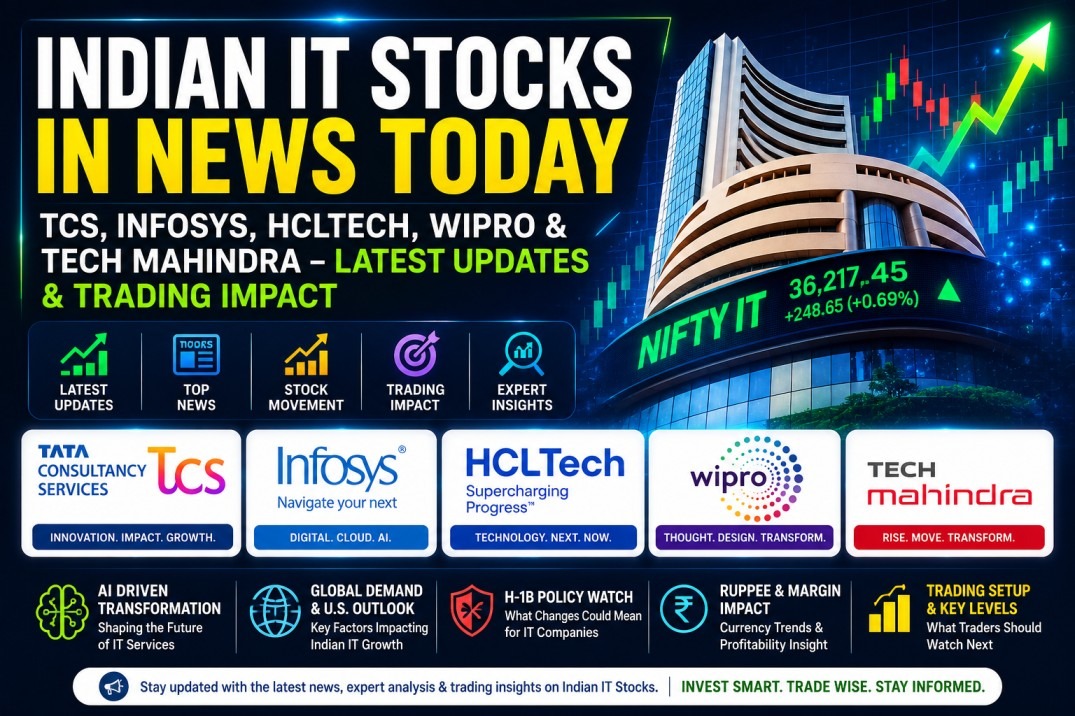
Indian IT Stocks in News Today: TCS, Infosys, HCLTech, Wipro & Tech Mahindra — Latest Updates & Trading Impact
Indian IT stocks in news today: Get the latest updates on TCS, Infosys, HCLTech, Wipro and Tech Mahindra, key sector triggers, market impact and trading insights.
Indian IT Stocks in News Today
Indian IT stocks remain firmly on traders' radar as a combination of U.S. policy changes, artificial intelligence, global technology spending and company-specific developments continues to influence the sector.
On Thursday, August 27, major IT stocks traded mixed to weak, with the Nifty IT index giving up its early gains as investors turned cautious and booked profits. TCS, Infosys and HCLTech were among the large-cap stocks weighing on the index, while Tech Mahindra showed relative strength.
The bigger story, however, goes beyond today's price movement.
Investors are closely watching how Indian IT companies respond to the rapid adoption of AI, changing client budgets and uncertainty surrounding the cost of deploying skilled workers in the United States.
Here are the major IT stocks and developments traders should watch.
1. TCS: Porsche Deal Puts AI Strategy in Focus
Tata Consultancy Services (TCS) recently announced plans to acquire MHP, Porsche AG's automotive and consulting unit, for an enterprise value of €320 million.
The deal also comes with a five-year partnership between TCS and Porsche valued at approximately €1.25 billion ($1.46 billion).
The partnership will focus on using AI across Porsche's engineering, manufacturing, operations and customer-experience functions.
For TCS, the development is significant because it demonstrates how large IT contracts are increasingly being connected to AI transformation and measurable business outcomes rather than traditional outsourcing alone.
TCS Trading View
TCS shares closed around ₹2,252 on August 27, down roughly 0.84% for the session, according to market data reported that day. The stock remains well below its February 2026 52-week high.
For traders, the key issue is whether positive deal news can translate into sustained buying interest.
A large contract can improve sentiment, but traders should still wait for confirmation through price action and volume rather than buying purely because of a headline.
2. Infosys: AI, U.S. Demand and H-1B Concerns
Infosys continues to face the same broader sector questions: how quickly enterprise technology spending will recover and how AI will affect traditional IT-service pricing.
The company has also been affected by concerns surrounding proposed changes to the U.S. H-1B visa system.
The U.S. Department of Homeland Security has proposed a $103,265 fee for H-1B cap-subject petitions, putting Indian IT companies under renewed investor scrutiny because of their reliance on skilled-worker deployment to the United States. The proposal is not yet final and is subject to a public-comment process.
Infosys Trading View
Infosys closed at approximately ₹1,106.65 on August 27, falling 1.26% during the session.
The stock's performance shows why traders should watch both company-specific developments and broader policy headlines.
If H-1B-related uncertainty increases, the sector could remain under pressure. On the other hand, stronger U.S. technology spending or positive AI-related deal announcements could improve sentiment.
3. HCLTech: Watch AI Spending and Global Demand
HCLTech is another major Indian IT company exposed to changes in global technology spending.
The sector is going through a structural transition as clients increasingly expect IT providers to deliver more productivity at lower costs.
Recent industry reporting suggests that large Indian IT firms are shifting toward performance- and outcome-based contracts, with AI becoming an important part of that transition.
HCLTech Trading View
HCLTech ended August 27 at around ₹1,282.20, down approximately 1.37%.
Traders should watch whether selling pressure continues or whether the stock begins forming a base.
A potential recovery would be more convincing if it is supported by improving volumes and strength across the broader Nifty IT index.
4. Wipro: Cost Pressure and AI Transformation Remain Key
Wipro remains another major stock to watch as investors assess whether AI can eventually accelerate growth while maintaining margins.
The challenge for traditional IT companies is straightforward: clients want faster delivery, greater automation and lower costs.
That creates an opportunity for companies that successfully use AI to improve productivity, but it can also create pricing pressure.
Wipro Trading View
Wipro closed around ₹177 on August 27, slipping only slightly during the session. It performed relatively better than several large IT peers on the day.
For traders, relative strength can be useful.
If Wipro continues outperforming other large IT names while the sector remains weak, it could become a stock worth monitoring for a potential momentum setup.
5. Tech Mahindra: Relative Strength Stands Out
Tech Mahindra was one of the more interesting large-cap IT names during Thursday's session.
While several major IT stocks declined, Tech Mahindra gained around 0.80%, outperforming TCS, Infosys and HCLTech.
Intraday market data also showed Tech Mahindra trading higher during the session.
Relative strength doesn't guarantee future gains, but it can help traders identify stocks that are holding up better than their peers.
What Traders Should Watch
If Tech Mahindra continues to outperform the Nifty IT index while maintaining strong trading volume, traders may continue to keep it on their watchlist.
However, a single strong session should not be treated as confirmation of a long-term trend.
Why Indian IT Stocks Are Moving
There are four major themes currently driving the sector.
1. H-1B Visa Uncertainty
The proposed increase in the H-1B petition fee has become an important risk factor for Indian IT companies.
Because several major IT firms rely on U.S.-based employees and skilled-worker deployment, investors are assessing whether higher visa costs could affect margins, hiring strategies and delivery models.
The proposal is still subject to the regulatory process, so traders should distinguish between a proposal and a finalized rule.
2. Artificial Intelligence Is Changing IT Services
AI is no longer just a technology theme for Indian IT companies.
It is changing the way technology services are sold.
Large clients increasingly want measurable outcomes instead of simply paying for hours or employee headcount. Reuters recently reported that major Indian IT companies including TCS, Infosys, Wipro and HCLTech are adapting their contract models as clients demand more productivity at lower costs.
This creates both an opportunity and a risk.
Companies that successfully monetize AI could benefit from new demand, while traditional services could face pricing pressure.
3. Global Technology Spending
The health of the U.S. technology sector remains extremely important for Indian IT companies.
Strong spending on cloud computing, cybersecurity, enterprise software and AI infrastructure can eventually translate into more technology projects for Indian service providers.
On August 27, strong results from Nvidia and Salesforce were among the factors initially supporting IT sentiment before profit booking returned to the Indian market.
4. Weak Growth Expectations
The sector is also dealing with a slower growth environment.
Analysts have pointed to weak client spending, AI-related pricing pressure and geopolitical uncertainty as reasons for subdued growth expectations among India's largest IT companies.
That explains why even large contracts can sometimes fail to trigger a sustained stock rally.
Investors are looking not just for revenue growth, but for evidence that companies can maintain margins and generate profitable growth in an AI-driven market.
Indian IT Stocks Today: Quick Comparison
Stock | August 27 Trend | Key Theme |
|---|---|---|
TCS | ↓ | Porsche deal, AI transformation, H-1B risk |
Infosys | ↓ | AI spending, U.S. demand, H-1B uncertainty |
HCLTech | ↓ | Global demand and AI-led transformation |
Wipro | Slight ↓ | Relative strength and AI transition |
Tech Mahindra | ↑ | Relative strength and sector momentum |
The August 27 session showed a mixed picture rather than a uniform sector move.
What Should Traders Watch Next?
For the next few trading sessions, five signals deserve attention.
1. Nifty IT Direction
A sustained move in the Nifty IT index can provide confirmation for individual IT-stock trades.
2. U.S. Technology Stocks
Major U.S. technology companies can influence sentiment toward Indian IT stocks.
3. H-1B Policy Developments
Any significant change to the proposed H-1B fee could trigger fresh volatility.
4. AI Deal Announcements
Large AI transformation contracts could become important positive catalysts.
5. Trading Volume
Price movement supported by higher volume is generally more meaningful than a low-volume move.
Expert Advice: How to Trade IT Stocks Right Now
The Indian IT sector is currently a classic news-driven market.
That means traders should avoid making decisions based solely on whether a stock is green or red on a particular day.
Instead, combine:
News + Price Action + Volume + Sector Trend + Risk Management
For example, if an IT stock rises 3% following positive news but immediately gives up most of its gains, the headline may have already been priced in.
Likewise, if a stock breaks an important resistance level with strong volume while the entire IT sector is strengthening, the technical setup may deserve closer attention.
The key rule:
Don't chase the first move. Wait for confirmation.
And always define your stop-loss before entering a trade.
Which Indian IT Stock Is Strongest?
There is no single stock that can be declared the “best” purely from one day's movement.
Large-cap names such as TCS, Infosys, HCLTech, Wipro and Tech Mahindra have different business mixes, client exposure, growth profiles and technical structures.
For short-term traders, relative strength and volume can be more useful than simply choosing the company with the biggest percentage gain.
For long-term investors, valuation, earnings growth, cash generation, margins and AI strategy deserve greater weight.
Final Takeaway
Indian IT stocks are entering an important period of transition.
AI is changing how IT services are delivered, H-1B policy could affect U.S. delivery costs, and global technology spending remains a key driver of future growth.
At the company level, TCS has attracted attention through its Porsche transaction and major AI-focused partnership, while Tech Mahindra showed relative strength in today's session. Meanwhile, Infosys, HCLTech and Wipro remain sensitive to broader sector sentiment and global demand.
For traders, the most important thing is not predicting every move.
It is identifying which news actually changes the fundamentals, waiting for price confirmation and managing risk when the market disagrees with your view.
VedList Discover will continue tracking the major developments affecting India's IT sector and the stocks most likely to react.
Disclaimer
This article is for educational and informational purposes only and should not be considered investment advice, a recommendation, or a guarantee of returns. Stock-market investments involve risk. Traders and investors should verify live market prices and conduct their own research or consult a SEBI-registered investment professional before making investment decisions.
50 FAQs: Indian IT Stocks in News Today
1. What are Indian IT stocks?
Indian IT stocks are shares of companies that provide information technology, software, consulting, cloud, cybersecurity, engineering and digital services. Major names include TCS, Infosys, HCLTech, Wipro and Tech Mahindra.
2. Which are the major Indian IT stocks?
Some of the most widely followed Indian IT stocks include TCS, Infosys, HCLTech, Wipro, Tech Mahindra, LTIMindtree, Mphasis, Persistent Systems and Coforge.
3. Why are Indian IT stocks in the news today?
Indian IT stocks can come into focus because of company results, large contracts, AI developments, U.S. technology spending, currency movements, global market trends, regulatory changes and other major business announcements.
4. Why is the IT sector important for the Indian stock market?
The IT sector contains several large companies with significant market capitalisation. Their performance can influence major indices and is closely linked to global technology spending.
5. What affects Indian IT stock prices?
IT stock prices can be influenced by earnings, revenue growth, margins, deal wins, client spending, AI adoption, U.S. economic conditions, currency movements, employee costs and investor sentiment.
6. Is TCS a good stock to watch?
TCS is one of India's largest IT companies and is closely followed by investors. Traders should evaluate its latest price action, earnings, deal wins, valuation and broader IT-sector trend before making decisions.
7. Why is TCS in the news?
TCS can attract investor attention because of major contracts, acquisitions, AI initiatives and developments involving large international clients. Its Porsche-related transaction and AI-focused partnership have recently been important developments.
8. What is the latest TCS trading trend?
The latest trading trend should be checked using live market data because prices can change throughout the trading session. Traders should combine price movement with volume, support, resistance and sector performance.
9. Is Infosys a good stock to watch?
Infosys is one of India's largest technology-services companies and remains an important stock for monitoring global IT demand, AI adoption, margins and U.S. business conditions.
10. Why is Infosys important for IT-sector traders?
Infosys is a major index constituent and its price movement can influence sentiment across the Indian IT sector. Its results, guidance and major client announcements are closely watched.
11. Why is HCLTech in the news?
HCLTech can attract attention because of technology contracts, AI initiatives, cloud services, engineering services and changes in global enterprise technology spending.
12. Is HCLTech affected by AI?
Yes. AI can create additional demand for consulting, cloud, data and automation services while also putting pressure on traditional technology-service pricing.
13. Why is Wipro important for traders?
Wipro is one of India's major IT-services companies. Traders often monitor its earnings, deal wins, margins, AI strategy and relative performance against other IT stocks.
14. Why is Tech Mahindra in the news?
Tech Mahindra is closely watched because of its exposure to telecommunications, enterprise technology, digital transformation and AI-related services.
15. Which Indian IT stock is strongest today?
There is no permanent “strongest” IT stock. Relative strength can change during the session. Traders should compare individual stocks with the Nifty IT index and examine volume and price action.
16. What is Nifty IT?
Nifty IT is a sectoral stock-market index that tracks major listed Indian IT companies. It is commonly used to measure the performance of the Indian technology sector.
17. Why does Nifty IT move?
Nifty IT can move because of company earnings, global technology stocks, U.S. economic conditions, currency movements, interest-rate expectations, AI developments and sector-specific news.
18. What is the relationship between Nifty IT and Nifty 50?
Several IT companies are constituents of the Nifty 50. Therefore, major movements in large IT stocks can contribute to changes in the broader Nifty 50 index.
19. Does the U.S. market affect Indian IT stocks?
Yes. Indian IT companies generate substantial business from international markets, particularly the United States. Changes in U.S. technology spending and economic expectations can therefore influence investor sentiment.
20. Why is the U.S. economy important for Indian IT companies?
A large portion of technology-services demand comes from international clients. If companies increase technology budgets, Indian IT firms may benefit from greater project and outsourcing opportunities.
21. How does the U.S. dollar affect Indian IT stocks?
The U.S. dollar can influence IT-company revenue and margins because many Indian IT companies earn significant revenue in foreign currencies. Currency movements can therefore affect reported financial performance.
22. How does the Indian rupee affect IT companies?
A weaker rupee can potentially benefit exporters by increasing the rupee value of foreign-currency revenue. However, the overall impact depends on hedging, costs, employee expenses and other factors.
23. What is the H-1B issue for Indian IT stocks?
H-1B-related policy changes can affect companies that rely on skilled professionals working in the United States. Investors therefore monitor proposed changes because they could influence hiring costs and delivery models.
24. How could higher H-1B costs affect Indian IT companies?
Higher costs could increase expenses for certain U.S.-based workforce models. Companies may respond by increasing local hiring, using offshore delivery centres or changing workforce strategies.
25. Is the H-1B fee proposal already final?
Not necessarily. A proposal and a finalized regulation are different things. Investors should check official U.S. government announcements for the latest status before trading on H-1B-related headlines.
26. How is AI affecting Indian IT stocks?
AI creates new opportunities in consulting, automation, data, cloud and software development. At the same time, it may reduce demand for some traditional services or put pressure on pricing.
27. Is AI positive or negative for Indian IT companies?
It can be both. Companies that successfully convert AI demand into profitable services may benefit, while businesses heavily dependent on traditional labour-intensive services could face disruption.
28. Which Indian IT stocks are exposed to AI?
Most major Indian IT companies, including TCS, Infosys, HCLTech, Wipro and Tech Mahindra, are investing in AI-related services, platforms and partnerships.
29. What are outcome-based IT contracts?
Outcome-based contracts link payments more closely to the business results or measurable outcomes delivered by a technology provider rather than simply the number of employees or hours involved.
30. Why are outcome-based contracts important for IT stocks?
They could change how IT companies generate revenue and measure productivity. Investors are watching whether AI allows companies to deliver greater value while protecting revenue growth and margins.
31. What should traders check before buying an IT stock?
Traders should review the broader market trend, sector direction, price action, volume, support and resistance, company-specific news and risk-to-reward before entering a position.
32. What is support in stock trading?
Support is a price area where buying interest has historically appeared. It can act as a potential floor, although support levels can fail during strong selling.
33. What is resistance in stock trading?
Resistance is a price area where selling pressure has historically appeared. A sustained breakout above resistance can sometimes indicate stronger momentum.
34. What is a breakout?
A breakout occurs when price moves decisively beyond an important support or resistance level. Traders often look for volume and follow-through to confirm whether a breakout is genuine.
35. What is a false breakout?
A false breakout occurs when price temporarily moves beyond a key level but quickly returns inside the previous trading range. It can trap traders who enter too early.
36. Why is volume important when trading IT stocks?
Volume shows the level of trading activity behind a price movement. A breakout accompanied by strong volume may provide more convincing confirmation than a breakout occurring on very low volume.
37. Should traders buy IT stocks after a large price increase?
Not automatically. Chasing a sharp move can increase risk. Traders should assess whether the move is supported by volume, news, market structure and a reasonable risk-to-reward setup.
38. Should traders buy an IT stock just because it has fallen sharply?
No. A falling stock can continue declining. Traders should look for evidence of stabilisation or a confirmed reversal instead of assuming that a lower price automatically represents value.
39. What are top gainers?
Top gainers are stocks that have recorded the largest percentage increases during a particular trading period. They can help traders identify stocks experiencing strong buying interest.
40. What are top losers?
Top losers are stocks showing the largest percentage declines during a particular period. They can highlight selling pressure, negative news or weak sector sentiment.
41. Are top gainers always good stocks to buy?
No. A top gainer may already have moved significantly and could experience profit booking. Traders should investigate the reason behind the move before considering an entry.
42. Are top losers always stocks to avoid?
No. A falling stock may eventually recover, but traders need to understand why it declined. Company fundamentals, news and technical structure should be considered before making a decision.
43. What is market breadth?
Market breadth measures how many stocks are rising compared with how many are falling. It can help traders understand whether an index move has broad participation.
44. Why should traders watch FII and DII activity?
Foreign Institutional Investors and Domestic Institutional Investors are major participants in Indian markets. Their buying and selling trends can provide additional context about market sentiment.
45. Does FII selling always mean the market will fall?
No. Institutional flows are only one market indicator. Domestic buying, corporate earnings, global markets and technical factors can offset or amplify FII activity.
46. What global factors should IT-stock traders watch?
Traders can monitor U.S. technology stocks, Federal Reserve expectations, bond yields, crude oil prices, currency movements, global economic data and major technology-company earnings.
47. What is the best time to trade Indian IT stocks?
There is no universally best time. Volatility can be higher around the market open and during major news events. Traders should choose a timeframe and strategy that matches their risk management and experience.
48. Is technical analysis enough for trading IT stocks?
Technical analysis can help identify trends, momentum and important price levels, but it does not eliminate risk. Combining technical analysis with company news and broader market conditions can provide better context.
49. What is the biggest risk when trading Indian IT stocks?
Major risks include unexpected news, global economic weakness, changes in technology spending, AI disruption, currency volatility, policy changes and sudden market-wide selling.
50. What is the most important advice for trading Indian IT stocks?
Don't trade the headline alone. Trade confirmed price action and manage risk. Before entering a position, understand the catalyst, check the technical setup, define your stop-loss and avoid risking more capital than you can afford to lose.
Extra pointers for Indian readers
The guide above stays the main reference. The table and questions below help you act on it – compare providers, confirm fees, and search locally when you are ready.
At a glance
| What to check | Why it matters | What "good" looks like |
|---|---|---|
| Scope of work / service | Stops bill shock later | Written line items, not one lump sum |
| Service area | Travel fees add up | Clear pincode or landmark coverage |
| Reviews (recent) | Old 5-stars mislead | Patterns about timing, billing, attitude |
| Response time | Shows reliability | Same-day reply during business hours |
| Cancellation rules | Protects your deposit | Plain language on WhatsApp or email |
| Extra fees | Budget planning | Quoted before work starts |
Figures and timelines vary by city and provider — use this table for planning, not as a price guarantee.
Good local decisions are boring in a healthy way: clear scope, clear price, clear timing.
Frequently asked questions
Is Indian IT Stocks in News Today: TCS, Infosys, HCLTech, Wipro & Tech Mahindra – L different in metro cities and smaller towns?
Usually yes. Availability, pricing, and travel charges shift between metros and tier-2 cities. Filter by your city or locality, then confirm service area on a quick phone call before you pay.
How do I know if a listing for indian it stocks in news today: get the latest updates on tcs, infosys, hcltech, is still active?
Treat online hours as a hint. Call or WhatsApp the number on the listing, ask if they take new bookings this week, and note who you spoke with. That single step prevents many wasted trips.
What should I prepare before contacting providers about indian it stocks in news today: get the latest updates on tcs, infosys, hcltech,?
Have your location landmark, preferred date or time window, budget range, and any must-haves written down. Providers answer faster when your brief is specific instead of "how much?" alone.
How local is "near me" in practice?
Search tools use city and locality pins, but providers may still charge travel outside a radius. Confirm they serve your pincode or landmark before scheduling.
Is the cheapest quote always the best deal?
Rarely. Lower quotes may exclude tax, travel, materials, or cleanup. Compare line items and ask what happens if the job runs long or needs a return visit.
Do prices for indian it stocks in news today: get the latest updates on tcs, infosys, hcltech, include GST?
Not always on the first quote. Ask whether GST is extra, whether you need a formal invoice, and what name will appear on the bill – especially for business reimbursements.
Does it matter which city I search from (e.g. Mumbai)?
Yes. Start with your actual city or locality filter. A great provider in another city is irrelevant if they will not travel to you without heavy surcharges.
Can I pay in cash or UPI – what is safer?
UPI with a note in WhatsApp is common and leaves a trail. For large event or renovation payments, staged transfers tied to milestones reduce risk for both sides.
How do I report outdated information on a listing?
Use contact options on VedList Discover or reach support if something looks wrong. Owners can also claim listings to correct phone numbers and hours directly.
Should I call or WhatsApp first?
WhatsApp lets you share location pins and photos; calls resolve urgent timing faster. Try the channel the listing promotes, then switch if nobody responds within a reasonable window.